
Not six-wingèd, nor a fiery wheel,
not four-bodied, though a living being,
human but for other human’s seeing
only what they a priori feel
to be true. Did he say fuck? Did he steal?
Was he sometimes prone to disagreeing?
Black? A teen? All but guaranteeing
some journalistic posthumous appeal
to see the nuance, meaning the bad sides.
No life is a story, and no story has
two sides: it is a universe, expanding,
not some taxonomic Alcatraz.
Here is the truth your subtlety elides:
there is no peace surpassing understanding.
Media
A Love Poem Awkwardly Inspired By a Stupid Video Feature at Slate.Com
Art, Books and Literature, Culture, Media, Poetry, Things that Actually HappenDo the rights and freedoms we currently enjoy mean that now is the best time in history to be gay?
When was the best time ever to be gay?
It was when we met. Before that we
were accidents of sex taxonomy;
now we’re texts and winks throughout the day.
Were we to travel back through history,
find ourselves in Death in Venice’s day,
or lounging like ancient Greeks carved in clay
as charms against queer specificity,
I’d still measure the good from when I first
swiveled a barstool so our knees would touch
and laughed too loud and hard and talked too much
and covered my nerves with beer and was the worst.
You still came home with me, and stayed, and here
we are regardless of the marked and measured year.
A Prophet of HaShem Whose Name Was Oded
Culture, Justice, Media, Religion, War and PoliticsOne character in my current novel-in-progress remarks at a point that God’s non-existence is a joke that proves He is a Jew, a sentiment that’s guided my own non-relationship with the Old Man since around the time the act curtain dropped on my bar mitzvah and we all retired to the Uniontown Country Club for bad chicken. I became a bar mitzvah in a Conservative synagogue—it was the slightly more stable of the two aging congregations in Uniontown—but I was really raised Reform. I am still moved by the High Holy Day liturgies, and I retain a great fondness for the Friday Night Shabbat service. But.
Somewhere along the way, someone smuggled in the Prayer for the State of Israel, a scandalous little piece of political agitprop that’s always made me cringe. Depending, I think, on the congregation and the prayer book, it either joined or supplanted the silly but less objectionable prayer for political leaders, a sort of broad wish-to-the-wind that our rulers comport themselves decently and conduct themselves with sage restraint—you can understand why a diasporic community would consider that a reasonable hedged bet, a proper blessing for the Czar, so to speak.
The Prayer for the State of Israel, on the other hand, has the Cold War stink of a kindergarten classroom being drummed to its feet to recite the Pledge of Allegiance. Written in 1948, the year of the Nakba, it further affirms in the minds and hearts of so many American Jews an indelible link between spiritual Judaism and political Zionism. I always wonder that it doesn’t seem out of place in a Temple full of Americans, but then, I see some Miami Beach shonda babbling excuses for atrocity on the cable news programs, and I think, Oh. Oy.
American Jews have been bought off with Birthright beach vacations in Tel Aviv and campfire temple trips and a pack of lies about an empty desert waiting to be planted with those trees we bought in Sunday School with the leftovers of our Tzedakah money. The next time you see some terrible white man wondering where are the Muslim moderates who will condemn whatever dictator or terrorist or cartoon-villainously acronym’d insurgency the great minds behind CNN et al. are on about in a given week, ask yourself, where are the American Jews who will speak against the Israeli pogrom in Gaza? They are out there, of course, but too quiet, and too few.
The terrible truth is that Israel was infected from the moment of its birth with the European evils whose virulent, 20th-centurty apotheoses necessitated, in the minds of so many, the creation of Israel in the first place, and we Jews, through Israel, have become a sick reflection of our own historic persecutors. I am not even speaking of the still unique evil of Nazism, although in the more extreme eructations of Israeli hard-liners, you do hear the debased language of racial purity and superiority. I am thinking of the old, durable, seemingly ineradicable traditions of pogrom, persecution, expropriation, and colonization. The Israelis possess the imperial arsenal of a modern Western nation-state, which camouflages the essentially primitive, pre-modern nature of their policy toward the Palestinians. The state of Israel is behaving like a village mob. Palestinian tunnels are the poisoned well. The Israelis are killing and lighting fires. “We will drive them out!” Where will they go? How will they escape? “They will have to figure it out, the devils!” But you forced them into the ghetto in the first place. “Yes, and they should be happy for what they have!” The US stands by like a distant monarch, its silence and occasional provision of more kindling a kind of majestic assent.
It would be comforting to say simply: I wash my hands of all of you. But we have accepted a state made of our religion, and that state is behaving abominably, unforgivably. It is a shame that we will not erase in a hundred years.
Bossa Nova
Culture, Economy, Media, Sports, War and PoliticsI’m only a casual soccer fan—hardly even a fan at all—but I do love hockey, a sport that’s in many regards soccer’s bruising inverse, a sort of deranged, wintry fraternal twin to the beautiful game. Hockey is America’s fourth big-league sport, and despite two consecutive Stanley Cups for Los Angeles and a general conviction among the cognoscenti that Western play is the superior style these days, it’s only in the icy, soggy band that stretches from Minnesota through the Great Lakes before curling up to Boston that the sport has anything like real prominence in the US. In bad football years in Pittsburgh, of which, lately, there’ve been more than a couple, the Penguins become the preeminent local team. But even here, any real appreciation and understanding of the sport is elusive, and Pittsburghers will sit over their big Yeunglings at the bar arguing with a straight face that Lemiuex was better than Gretzky before turning to the screen to shout, alternately, “Hit him!” and “Shoot the puck!” Almost invariably, neither would be a good idea. Hockey’s speed and bottled violence distract from the fundamental tactics of the game: position, possession, and puck movement; the critical importance of lines, line-changes, and specific match-ups. Besides which—there is the unaccountable power, especially in the playoffs, of the hot goalie. After a miraculous 2009 Stanley Cup run that kicked off with a mid-year coaching change, my Pens have fallen, again and again, in the pre-Cup playoffs, outclassed by lesser squads playing superior tactical hockey. The Penguins have two of the preeminent stars of the current game, which is fine during the looser, slower play of the regular season, but in the playoffs, stars matter less than systems. This is true in most team sports played at the highest professional levels. Hey, San Antonio.
Anyway, I mention this because Franklin Foer has a weird piece in The New Republic arguing something or other about the World Cup. This tournament, he frets, “lacked a historically great team”; the Germans only beat Brazil because of something to do with psychology; “Germany doesn’t have anything close to a transcendent player.” Well, let’s unpack that last bit:
Despite a roster filled with excellent players, Germany doesn’t have anything close to a transcendent player. (Neuer, at goalkeeper, is the only player who comes close.) And there’s nothing paradigm-shaking about the German style of play. The fourth German World Cup will likely be remembered much like the past three—the triumph of a great system and a team that doesn’t squander its chances.
That “despite” is doing yeoman’s work. The romance of movie-theater sport is the transcendent player; the reality of championships is blocky teamwork, especially in a game like soccer, where scoring chances are generally few. A cliché of American football may be appropriate here: “We’ve got to convert.” That is to say, the difference between winning and losing at the highest level of team sport is not squandering chances.
Yes, Messi was relatively quiet, but the championship game was really quite thrilling, and Germany’s single, winning goal in extra time was one of the most beautiful I’ve ever seen. Since I had no natural rooting interest in the tournament, I was hoping for Argentina to pull it out, based on no special affinity beyond a vaguely political preference for a national—if not sporting—underdog. Ah well. The game was a thrill because it could have gone either way. The pyrotechnics of scoring are dull; a sport in which most games are close games is a good sport. The Brazilian collapse was a wild outlier, but the Group Stage that Foer calls “affirmative, almost joyous”—meaning something by those words that no native speaker of English has ever meant before, I’m quite certain, as I haven’t the foggiest idea what they could possible mean in context—did not “[reflect] a buried side of human nature”; it reflected regular season play. Then the best teams moved on and things tightened up. The Germans were a great playoff team. Here’s another sports cliché: they didn’t make many mistakes. The ability to read a cultural moment into the style of a sporting victory is, I suppose, the sort of thing that gets you a job at The New Republic, but if that’s the sort of thing that turns you on about sports, then here, let me explain to you in great detail how American football is sublimated homoeroticism while you’re biting your nails over a critical field goal.
This ability to distill any fundamentally human activity into some dour reflection on “the geopolitical situation” strikes me as the saddest, most pathetic of psychic pathologies, a sort of illness of the soul that makes real joy and affirmation impossible to those who’ve been infected by it. It is, of course, also a prerequisite for writing for that certain kind of middlebrow American magazine that more and more resembles an outdated sanitarium full of mad—but not too mad—patients padding around the gardens believing themselves to be some combination of Clausewitz, de Tocqueville, Hans Castorp, and Jesus Christ. Sometimes a cigar is just a cigar, but sometimes a cigar is Vladimir Putin’s surely immense . . .
“Vladimir Putin loomed at the center of the Maracanã today. And in a way, he’s loomed over this whole past month of soccer.” I can fairly guarantee you’re the only one who thought so, Franklin. Forgetting the months of protest in Brazil’s major cities, the forced evacuations of neighborhoods, the official violence, the waste and fraud of the whole affair, Foer pronounces the Brazilian games merely acceptably corrupt—a charming, minor, Latin-American corruption, unlike those dastardly Russians and evil Qataris. This is pure projection of the fixations of the American political class onto an unrelated event; the obsessions of the pundit class are the Vaseline rubbed on the lenses through which they view the world. The distinction between “the grotesque spectacles of preening authoritarian regimes” and the “moment of relative innocence” that was the Brazilian record of minor “misdeeds” is one largely without a difference. Authoritarianism is just a name for any country whose politics you don’t like at any given moment, not a descriptor of an actual political system. I am pretty convinced that Dilma Rousseff is somewhat less personally odious than Vladimir Putin, but she still sent in the riot cops. Meanwhile, I dare you to compare, for what it’s worth, their approval ratings in their respective countries. The world is more complicated than the never-correct and now-less-correct-than-ever teleology of West vs. East. There are real differences between conferences in the NHL; in “geopolitics” rather less so. Were the London Olympics really any less a “grotesque” and “preening” a “spectacle” than the Beijing Games; were either qualitatively different from Sochi? Maybe Western Europe and the US have just been more successful at pre-relocating their poor out of the attractive potential Olympic villages.
International sporting events are—of course—opportunities for the governments of host countries to transmogrify their failures into tawdry demonstrations of national purpose and unity. Hey, it beats invading Iraq, I guess. Is Russian state media sweeping Putin’s record on gay rights under the soccer pitch really more morally odious than the pages of the major organs of American media giving over their editorial and opinion pages to the endless stream of reactionary Neoconservatives and “National Greatness” Conservatives arguing that our own national renewal is just one more bombing sortie away, forever? Qatari slave labor is utterly hateful, but so is America’s internment of tens of thousands of child refugees in desert concentration camps. There is no precise taxonomy and rubric of national wrongdoing that allows us to rank these things like a deranged Wikipedia list: the world’s largest freshwater lakes by volume; the world’s most populous urban agglomerations; the world’s most evil national regimes. I would be perfectly pleased to have no more international sporting events ever, anywhere, but if we must, then the surest way to keep the grotesquerie to a civilized minimum is to always and ever insist that they are only games.
De Rerum Natura
Culture, Media, Plus ça change motherfuckers, Poetry, War and PoliticsReihan Salam and John McCain have scored
a six-pack and a fix of krokodil;
the war is over; both men need to feel
the war is never over. They are bored.
The decadent world they hate is drifting toward
. . . well, something. Sense-starved, they’ll steal
right up to death, which is all that’s really real:
irrevocable promise of its own reward.
Outside the window of the Georgetown study
where they melt in leather chairs among the shelves
of Boots and Kagans leans a homeless vet;
war muddied his boots; now his mind is muddy
with several sectarian civil-warring selves.
Someone calls the cops, reports this threat.
A Newspaper Columnist Takes Drugs and Inhabits the Consciousness of an Animal
Culture, Media, Poetry, ReligionSomewhere over Silver Plume, a hawk
stoops toward a rodent in the underbrush;
the mountains are green, the small streams rush
with new snowmelt; it’s hard not to be mawk-
ish—nature needs and hates our idle talk
about its beauty. Here in the hotel hush,
the window facing sunset’s westward blush,
I ward the door against housekeeping’s knock
and kneel into this newly legal prayer
to these foreign numina; they are displeased
and I, untethered, terrified, become
the mouse beneath the raptor-crowded air;
unlike a god, a bird can’t be appeased;
I squeak; it wheels; I freeze: immobile; dumb.
A Sulz on Women
Economy, Education, Justice, Media, Plus ça change motherfuckers, War and PoliticsA few brief thoughts on the New York Times-Sulzberger-Abramson affair.
- It’s awfully difficult to feel badly for income discrepancies where people are making hundreds upon hundreds of thousands of dollars. Beyond a certain income level, which I would set at significantly less than $100,000 per year, it’s all just surplus value; its only purpose—if that word applies—is luxury purchasing for purposes of status signaling. This is not to say that women executives should be paid less than their immediate male counterparts; rather, no one should be paid so much money to be a general manager.
- In any case, the focus on corporate income inequality between men and women is a classic example of mistaking a symptom for a syndrome. Women are not paid less than men—whether in the executive office or at the greeters line in WalMart—because late capitalism is malfunctioning, but rather because that is a function of capitalism. Yes, women’s inequality long predates the modern economy, but the systems of capitalism incorporate preexisting forms of social and material inequality to their own end. A great deal of time and attention and political will is about to be frittered away “addressing the growing concern” over income inequality in the nation’s corporate media. Meanwhile, the question of what it means to have the nation’s singular newspaper a publicly traded corporate entity and the nation’s media in general an elite enterprise accessible as an occupation almost solely to those whose families have the previously acquired resources to support their effectively unpaid labor for as much as a decade will go largely unasked and entirely unanswered.
- In other words, yes, it is a problem in a narrowly defined sense that a woman reporter for the Times is making eighty grand a year while her male colleague is making ninety-five, or what have you, but it is a problem in a much broader sense that she went to Bryn Mawr and he went to Brown and both of their New York rents were floated by their parents for 4-5 post-undergraduate years of internships and sub-$30K reporting gigs; that these two employees consider this a natural state of affairs; that their employer considers it so (obviously) as well. These are the people who report on “income inequality.” In a very circumscribed sense, they experienced and performed low-income labor—for them, a rite of passage, a way station.
- Here is where the difference between the C-level and the checkout lane start to look a little more important. Let’s go back to that certain level of income. For all practical purposes, the difference between $400K and $500K—this is roughly the range we’re talking about for these Times editors—is meaningless. There is nothing of actual value that these people can’t buy; they can buy anything they reasonably want or need many times over. The idea that the arithmetical equality of dollars-per-annum for a bunch of rich people is a measure of anything beyond mere counting is the fundamental error here. What is at stake is a status claim.
- Meanwhile, a representative sentence from The New York Times:
Republicans contended [that Seattle’s attempt to raise the minimum wage to $15/hour] would be a job-killer, while Democrats asserted it would help alleviate poverty. Economists said both might be right.
- Wait, that isn’t fair! The Times has strongly editorialized in favor of raising the minimum wage!
- Well, sure, but then again, a few months later.
- Stop looking at the stories and start looking at the coverage. The narrative it builds is of a fraught and deeply technical political and economic question being argued passionately at the highest levels of government, in academia, and in the media—a debate mediated by and, in a perverse sense, for people who are making hundreds of thousands of dollars—the sort of people for whom there is something called “the economy.” “Both might be right”!
- These are the sorts of ersatz and imponderable conversations that capitalism, personified by its functionaries, likes to have both with and about itself. Have you recently used the phrase “rising inequality.” Ding-ding-ding! You listen with some anguish to NPR pieces on the “growing gap between the rich and the poor.” You, like the Times, recognize that it’s impossible to live on the minimum wage alone, and that even $15/hour condemns a wage-earner to a life of struggle and fretting over the bills. But isn’t it true that mandated upward pressure on the low end of wages will force businesses to slow hiring? The unemployment rate is so high! We need more jobs! No, we need good jobs! Oh, woe, what is a “the economy” to do?
- Pause. Here’s a question that you rarely hear anyone ask. What is money? I’ve always been very fond of the late author Iain M. Banks formulation in his first science fiction novel. Money is a “crude, over-complicated and inefficient form of rationing.”
- Rationing! You mean, like communism?
- Yes, Virginia.
- Stay with me. In 2010, women comprised 47 percent of the total US Labor Force. Now, estimates differ, as the Times might say, but broadly speaking, women are assumed to make somewhere between 75-85% of what men make in, as the Times might say, broadly comparable positions.
- Okay, I want you to imagine the Times, or any similar publication, publishing an editorial that says women should not make as much as men for the same work because of the fundamental damage that “some Republicans” or “some economists” say that “equal pay” would do to our old friend, the economy.
- Because, after all, the cost of bringing the compensation of all women in the workforce into wage/salary parity with men would far exceed that of increasing the minimum wage—even dramatically—for the just several million people who earn it. So why, then, is the one a debate and the other a moral imperative?
- I’m glad you asked! Capitalism is a system of surpluses, and it allocates them upward. It gives more rations to people who already have a pile. Should women make as much as men, blacks as much as whites? Yes. But these debates are moral proxies for debates that we are not having, at least, not in the pages of the Times. The answer to the question of whether a woman line worker should make as much as the guy next to her is yes. The answer to the question of whether Jill Abramson should have made as much as Bill Keller is smash the system of state capital and reallocate the surpluses in the form of lifetime guaranteed housing, clothing, food, and study for everyone. I am not being crass here. There is, quite literally, plenty to go around.
- Yeah, well, how does this affect Hillary’s chances in 2016?
- There is, of course, a corollary debate. This debate has to do with the question of why it is that women in leadership roles are pushy and opinionated while men are strong and decisive, or, well, you pick the opposing pairs of adjectives—why, in short, is the behavior of women judged on measures of temperament, and men’s on measures of will? It strikes me that the actual question being asked here is: why, upon achieving a position of dominance, aren’t women as free to act like monstrous dickheads as men? The management behaviors ascribed to both Abramson and her predecessors are the worst kind of B-school blowhard psychopathy: management based on fear; power maintained by its own inconsistent application. These sorts of hard-driven, hard-driving, chair-tossing, dressing-down applications of personal power within a rigid hierarchy of authority are, like that big ol’ salary, a kind of surplus; an excess; an overage. So the question can’t be: how do we permit a few more women to behave like the lunatic men who’ve been running the show all these years, but how do we prohibit or prevent anyone from acting this way? And here, too, the answer is a more fundamental sort of levelling, because the other option, which is the false promise of our society, which is the belief that it is the duty of each person to scramble madly from the broad base toward the unattainable height, is a Sisyphean punishment where we all—well, most of us—under the weight of our own bodies are forever sent tumbling down the sides of the same brutal slope.
Theme: Amazing
Media, Movies, The Life of the MindJim Jarmusch’s Only Lovers Left Alive opens with blood-red titles in a font I will call Third Reich Martin Luther Sans Serif against a very slowly rotating star field. The text is so remarkably crisp at the edge and the rotation so leisurely that the impression is of words floating out of a deep field into your eyeballs, the sort of three-dimensional effect that none of the bogus 3D efforts of the last several regrettable years in cinema history has managed to accomplish. The opening credits disappear. The stars revolve more quickly, resolving into a spinning short play record. The pace is—I use the word advisedly—majestic; it’s languorous. There’s a point to this. I’ll get there in a moment.
Spiderman The Amazing Man 5 opens with a scene from Television’s Revenge. The reboot has retooled/retconned Peter Parker’s father into a sort of whistleblowing scientist for the Oscorp corporate octopus whose various executives and research mishaps are the source of all woe in the Spideyverse. It isn’t an inherently bad idea, although it could have all been sketched with a few lines of dialogue rather than shot as a broadcast-quality teaser episode on a fake-looking Gulfstream set. It’s all loud, cheap, and makes very little sense. Cut to hectic scene of Spiderman doing his thing and Paul Giamatti getting, if not earning, a paycheck.
You might say it’s unfair to compare the films, because one is a zillion-dollar tentpole blockbuster and the other is a stately art flick. In fact, one of the things I like about Jarmush’s picture is that it really isn’t an art flick; if stylized, then it’s still a genre flick, full of plenty of fun tropes pulled from every other vampire movie ever, including some pretty hilarious digs at the old Interview with a Vampire rock star conceit. I mean that as a compliment. Even its goofy literary references are as clunky as you’d find in a costumed flashback on The Vampire Diaries. Ohhh, Byron. Ohhhh, Marlowe. I choose to believe this was intentional. The movie is slow and quiet, but never not trashy fun.
Look, really, I’m not going to go to the trouble of reviewing either film. I’m only interested in a particular and pretty technical comparison of how to render a particular aspect of sense and consciousness in a filmic medium, and what it is that this says about a good movie versus a bad. Both movies, you see, have to find solutions to the question of how to display, on a practical level, superhuman sensitivity and sensory perception. Marc Webb, of Spiderman, does this in the same rote and over-produced manner as every other action movie that’s contemplated the question in recent memory. He slows down the frame, then the not-actual digital eye of the non-camera moves through the rendered images to record all those things that Spidey would notice with his Spidey sense. Sometimes, zip-zoom-boom, the whole thing then re-transpires at normal speed. Yawn. Chewing sounds from the audience. The collection of red pixels that is the movie’s star bounces around some more.
In Only Lovers, by contrast, the whole affair is deliberate and slow—also, very quiet, other than the music. When the rare outside sound intrudes—a group of nosy fans outside Tom Hiddleston’s vampire dump, a soda can opening and cutting a man’s finger on a plane—it registers so deeply against the quiet, and so intensely on the faces of Hiddleston and Swinton, our vampire pair, that we in the audience experience it in the same three dimensions as we experience those red letters against that background of stars. If you think of those times when you’ve watched TV late at night—you can’t sleep, but as the hours tick till morning, you find that the volume becomes oppressively loud, so you turn it down, only to find a few minutes later that the feeling’s returned, so you turn it down again—you have some idea of the sensitivity this implies; the weird feeling of noting everything. The effect is subtle and clear, and it renders the characters as simultaneously supernatural and real.
Only Lovers is 120 slow minutes that seem to be over the moment they’ve begun; Spidercorps 2: Not Without My Aunt May is 140 fast minutes that seem interminable. These are both schlock films about mythological creatures, but one of them is good. Its director and its stars give us time to notice; noticing is engagement; engagement is participation; participation is enjoyment; enjoyment is joy, which is why we go to the goddman movies in the first place, no?
Is this Your Homework Larry?
Culture, Economy, Media, The Life of the Mind, Uncategorized, War and Politics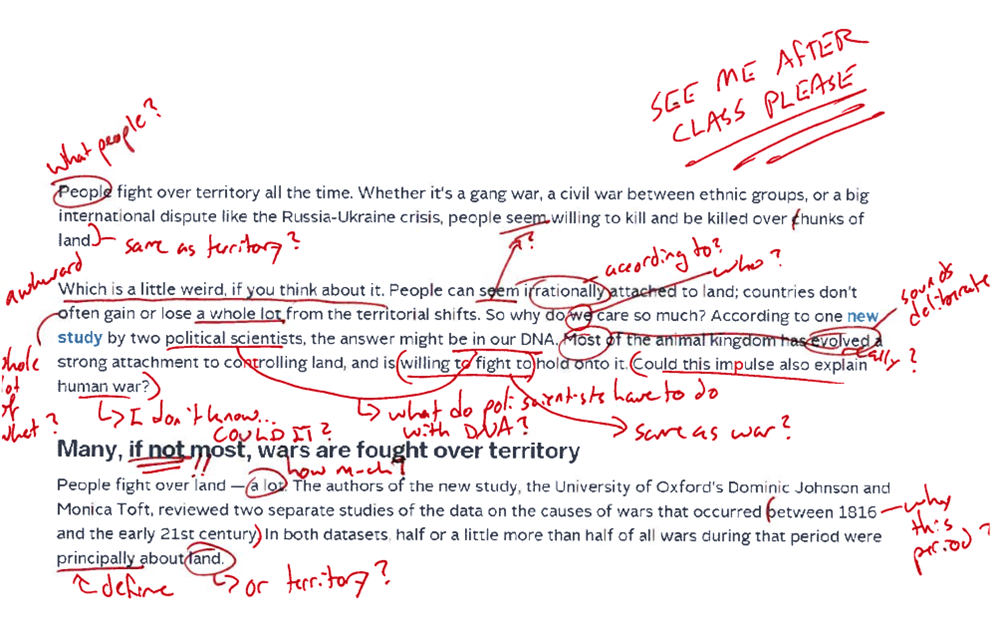
Among a certain class of Americans, those of us who go to “good” colleges and take, sometime during our freshman and sophomore years, some sort of introduction to sociology course, there is the universal experience of that one student. He is inevitably, invariably male; he is either in or has recently completed a course in biology, although he is almost certainly not a biology major; he finds, in almost every class, an opportunity to loudly and circularly suppose that some or other human social phenomenon is a direct analogue of some behavior in ant colonies or beehives or schools of fish or herds of gazelles. Mine was a boy who, after a section on suicide clustering, suggested that it could be explained quite easily, really; certain ants, after all, when ill or infirm, remove themselves from the nest, lest they burden their kin. So all those kids in Jersey, they, like, you know, they like knew that they were going to, like, be, like, a burden, you know, to society, because they weren’t, you know, going to, like, be successful or whatever, so, you know, you know what I’m saying.
He’s not without his charms. If consciousness is a continuum, from bacterium to baccalaureate, rather than just some crowning and discrete achievement of a select and tiny sliver of the mammalian class, then surely animals have plenty to teach us about ourselves, and surely animal societies have plenty to teach us about our own. And likewise, while I like to believe that our lives and beings are something more than the dull, material expression of DNA, that biology is not, in fact, destiny, I know that this belief amounts to a kind of self-praise and willful self-regard. “Oh, honey, you are special.” I believe in free will and self-determination, but let’s just say I accept that they must be subject to some reasonable natural limits.
But now over at Vox.com, Ezra Klein’s intrepid effort to out-USA Today USA Today, Zach Beauchamp has discovered two political scientists who have discovered “circumstantial” evidence that human wars are the genetic remnant of animal territoriality. DNA is mentioned, but there are no double helices in sight; what’s meant is something more akin to the “animal spirits” that Tristram Shandy was so concerned with, or perhaps a kind of pre-genetic, crypto-Mendelian, semi-hemi-demi-Darwinian understanding of trait inheritance. In this case, the authors of a study, and the author of the article, notice that animals are territorial, that humans are territorial, that both come into intraspecies conflict over territory, and therefore, ergo, voilà. It has the remarkable distinction of being both self-evidently correct and skull-crushingly wrong. The deep roots of human territoriality are animal, but explaining organized human warfare in this manner has the motel smell of a husband telling his wife that he’s been fucking other women due to evolutionary mating imperatives. “Babe, calm down! Have you ever heard of bonobos, huh?”
Beauchamp treats territoriality among animals as an imponderable feature of “animal psychology”—he doesn’t mention, and you’ve got to assume he just doesn’t know, that the behaviors are largely about resource distribution, and, well, ya wonder if that’s got anything to do with warfare? Eh . . . He says that we “evolved from” animals, which is another one of those strictly true but effectively incorrect statements, a recapitulation of the old teleology that makes evolution a unidirectional progression from low to high, with humans not only its ultimate achievement but also its point. (He also—this is an aside—confuses accountancy and finance, claiming that a $100 real loss is identical to $100 in opportunity cost, all this by way of clumsily explaining loss aversion.) He uses the phrase “just a theory.” He gets to the end of the penultimate paragraph, then:
Toft and Johnson just don’t have any studies of human biology or evolution that directly show a biological impulse towards territoriality.
Phlogiston! God Bless You!
I’m not a religious man, but I empathize with the religious when they call this hooey scientism, the replacement of one set of hoary mythological clichés with their contemporary TED-talk equivalent—I mean, talk about inherited traits. If this kind of thing is science, then it is less Louis Pasteur than it is Aristotle, the general observation of a couple of different things with some shared trait or simultaneity, and then a vast leap of logic alone across the evidenceless abyss. The purpose of such speculation is not to clarify, illuminate, or discover, and Lord only knows, we wouldn’t want to waste our time devising some kind of double-blind. This, after all, is political science. Its purpose, rather, is moral flattery, an up-from-the-slime story in which our more regrettable and barbarous traits as people are written off as the bad debt of our evolutionary ancestors. And speaking of moral flattery, you might notice that “gang wars” are mentioned, and “ethnic” conflict, and Crimea in this great gallery of weeping over our remnant animalism, but nowhere is it explained how land tenure explains what America was doing, for example, in Iraq.
An Angel of the Lord Appears to a Newspaper Columnist
Economy, Media, PoetryEssentially agnostic, he believes
the moral universe is of a kind
with the bureaucratic and efficient mind.
His is all incentives and reprieves.
He likes the rich. The poor are mostly thieves.
His paradise is just a well-designed
forced savings scheme, a contract signed,
less what the soul deserves than what it achieves.
If, alone, an angel of God most high
appeared to him beside a shallow stream
while on his way, a man in form, but bright
and terrible, he wouldn’t strive; he’d try
to reason the miracle down to just a dream,
the honor modest, the pleasure real, but slight.
 Jacob Bacharach