De Rerum Natura

Culture, Media, Plus ça change motherfuckers, Poetry, War and Politics

Reihan Salam and John McCain have scored
a six-pack and a fix of krokodil;
the war is over; both men need to feel
the war is never over. They are bored.
The decadent world they hate is drifting toward
. . . well, something. Sense-starved, they’ll steal
right up to death, which is all that’s really real:
irrevocable promise of its own reward.
Outside the window of the Georgetown study
where they melt in leather chairs among the shelves
of Boots and Kagans leans a homeless vet;
war muddied his boots; now his mind is muddy
with several sectarian civil-warring selves.
Someone calls the cops, reports this threat.

Goodbye Normal Genes

Culture, Science, The Life of the Mind

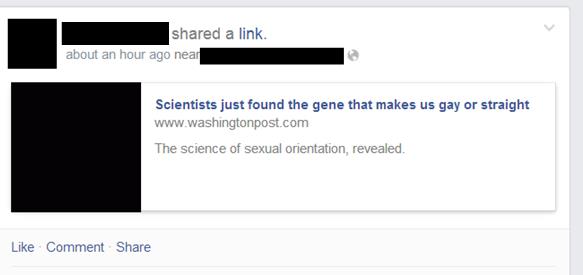
Those whom the gods would destroy, they first render in the unconditional declarative on Facebook:

genes

Click. The same revelations reappear, hedged around by caveats like the lonely straight girl in a gay bar. Oh, our genes—notice the plural?—could make us gay . . . or straight. The flight from pure causality continues in the text, which departs even the territory of sexual difference for an and-everything-in-between taxonomy of non-classification. Evolutionary biology, ladies and gentlemen, where some (or all) of our characteristics and behaviors are determined (in part, possibly) by some (or all) of our genes (among other factors).

By the end, we’re back in Kinsey scale territory:

It’s a bit like height, which is influenced by variants in thousands of genes, as well as the environment, and produces a “continuous distribution” of people of different heights. At the two extremes are the very tall and the very short.

In the same way, at each end of a continuous distribution of human mating preference, we would expect the “very male-loving” and the “very female-loving” in both sexes.

Gay men and lesbian women may simply be the two ends of the same distribution.

Ooooo, girl.

The desire to ratify scientifically our moral and social and economic postures and preferences is part of a generally cowardly morality that takes a look at some vile human prejudice and goes off searching for a pipette and a bell curve as a counter-scripture to whatever Bronze-Age prejudice a misunderstood God re-dredged up every time a louche Hellenism threatened to make Western civilization vaguely civilized. I’m glad that this fuzzy evidence is being wielded in favor of gay equality; I’m gay, after all. But I can’t help but see it as the boneheaded inverse of all the The New Republicans, Dark Enlightenment dweebs, and other direly self-afflicted determinist assholes forever trying to prove with the modern-day phrenology of intelligence testing that The Blacks Are Stupider. “We’re just asking the questions!” Yeah, yeah. Some of my best friends are black.

I’m sure genetic inheritance and gene expression do influence sexuality; likewise, intelligence and hair color and the desire to eat, or not to eat, cilantro; but the desperate reductivism that keeps popping up to declare that this or that immensely complex trait is the result of some butterfly-pinned nucleotide—and the attendant desire to draw some kind of socioeconomic conclusion therefrom—reeks of both the alchemical and the eugenic. God, remember the study about the genetic basis of American political affiliation? That’s what I’m talking about.

This is like when that weird-looking National Review gnome appeared a few days ago to declare that Laverne Cox is biologically not a woman and the Internet bravely rushed in to declare that scientifically she is. “He doesn’t understand the complexity . . .” And we were all treated to a series of semi-coherent expostulations on various human intersex conditions, as if that has anything to do with the social right of an autonomous human individual to decide whether she wants to live her life as a man or a woman or both or neither, less yet to determine against which physical expression of our species rather aesthetically unfortunate genital she wishes to press her own. If we make the concretized and inevitably temporary axioms of popular (I emphasize) science the preconditions of moral acceptability, then we are in big trouble, people. If Laverne Cox decides tomorrow that she wishes to be referred to by the pronoun Qfwfq  and that her gender is henceforth Parthogenetic Quintsexual Proteus Universal then it’s still no skin off my ass, whether ratified by double-blind or by dungeon-master.

Consider the study at hand. What it proposes, in fact, is that with the exception of a relatively small population on the long tails of the normal distribution, human sexuality exists along a fluctuating continuum, and even as one of those, ahem, long-tailed lovers myself, I can assure you all that some element of choice is involved in the expression of sexuality, gender, etc.—for me, to a lesser degree; for the Kinsey 4s out there, perhaps more. I went through periods of greater and lesser effeminacy (apologies for the word choice), especially earlier in my life; I’ve never been especially sexually interested in women, but I’ve certainly be attracted to them, sometimes, especially with close friends, with an intensity that shades into eroticism. Sexual morals should be built on the tripartite foundation of autonomy, self-determination, and consent, not on some fanciful on-off switch in the cells.

A Newspaper Columnist Takes Drugs and Inhabits the Consciousness of an Animal

Culture, Media, Poetry, Religion

Somewhere over Silver Plume, a hawk
stoops toward a rodent in the underbrush;
the mountains are green, the small streams rush
with new snowmelt; it’s hard not to be mawk-
ish—nature needs and hates our idle talk
about its beauty. Here in the hotel hush,
the window facing sunset’s westward blush,
I ward the door against housekeeping’s knock
and kneel into this newly legal prayer
to these foreign numina; they are displeased
and I, untethered, terrified, become
the mouse beneath the raptor-crowded air;
unlike a god, a bird can’t be appeased;
I squeak; it wheels; I freeze: immobile; dumb.

Thud. Ark. Enlightenment.

Culture, Economy, Poetry, Religion

It was reported that the companies
that built, then ruined, GoogleMaps and made
iTunes a hash and ruined blogs have stayed
mostly white and mostly dude—but please
it’s not for lack of trying! What this shows
is that our self-styled meritocracies
are skeins of self-indulged affinities,
where merit is a mirror reflecting bros.
Last weekend on the Carolina shore
we swam in the ocean; one of us worried about
spiders (spiders?); what I didn’t say
was the pale crabs we watched darting out
along the water line were also spiders
in a way; we are all judged, at the end of the day
by distant gods to whom we’re all outsiders.

The Lafayette Baths

Uncategorized

I heard it mispronounced as Charles Grief.
All right; that was me. I was nineteen
or so, an English major and a drama queen,
a boy-besotted druggie and a thief.
I wanted only what I wanted, chief
among those childish wishes to be seen
as an aristocratic aesthete-libertine—
casting that error in humorous relief.
Yesterday, one more court of appeals
struck down another law that said a man
can’t marry his special friend; time is a lathe
that carves as much as time’s a turning wheel
—everything is permitted that once was banned—
we are each the water in which we bathe.

A Sulz on Women

Economy, Education, Justice, Media, Plus ça change motherfuckers, War and Politics

A few brief thoughts on the New York Times-Sulzberger-Abramson affair.

  1. It’s awfully difficult to feel badly for income discrepancies where people are making hundreds upon hundreds of thousands of dollars. Beyond a certain income level, which I would set at significantly less than $100,000 per year, it’s all just surplus value; its only purpose—if that word applies—is luxury purchasing for purposes of status signaling. This is not to say that women executives should be paid less than their immediate male counterparts; rather, no one should be paid so much money to be a general manager.
  2. In any case, the focus on corporate income inequality between men and women is a classic example of mistaking a symptom for a syndrome. Women are not paid less than men—whether in the executive office or at the greeters line in WalMart—because late capitalism is malfunctioning, but rather because that is a function of capitalism. Yes, women’s inequality long predates the modern economy, but the systems of capitalism incorporate preexisting forms of social and material inequality to their own end. A great deal of time and attention and political will is about to be frittered away “addressing the growing concern” over income inequality in the nation’s corporate media. Meanwhile, the question of what it means to have the nation’s singular newspaper a publicly traded corporate entity and the nation’s media in general an elite enterprise accessible as an occupation almost solely to those whose families have the previously acquired resources to support their effectively unpaid labor for as much as a decade will go largely unasked and entirely unanswered.
  3. In other words, yes, it is a problem in a narrowly defined sense that a woman reporter for the Times is making eighty grand a year while her male colleague is making ninety-five, or what have you, but it is a problem in a much broader sense that she went to Bryn Mawr and he went to Brown and both of their New York rents were floated by their parents for 4-5 post-undergraduate years of internships and sub-$30K reporting gigs; that these two employees consider this a natural state of affairs; that their employer considers it so (obviously) as well. These are the people who report on “income inequality.” In a very circumscribed sense, they experienced and performed low-income labor—for them, a rite of passage, a way station.
  4. Here is where the difference between the C-level and the checkout lane start to look a little more important. Let’s go back to that certain level of income. For all practical purposes, the difference between $400K and $500K—this is roughly the range we’re talking about for these Times editors—is meaningless. There is nothing of actual value that these people can’t buy; they can buy anything they reasonably want or need many times over. The idea that the arithmetical equality of dollars-per-annum for a bunch of rich people is a measure of anything beyond mere counting is the fundamental error here. What is at stake is a status claim.
  5. Meanwhile, a representative sentence from The New York Times:

Republicans contended [that Seattle’s attempt to raise the minimum wage to $15/hour] would be a job-killer, while Democrats asserted it would help alleviate poverty. Economists said both might be right.

  1. Wait, that isn’t fair! The Times has strongly editorialized in favor of raising the minimum wage!
  2. Well, sure, but then again, a few months later.
  3. Stop looking at the stories and start looking at the coverage. The narrative it builds is of a fraught and deeply technical political and economic question being argued passionately at the highest levels of government, in academia, and in the media—a debate mediated by and, in a perverse sense, for people who are making hundreds of thousands of dollars—the sort of people for whom there is something called “the economy.” “Both might be right”!
  4. These are the sorts of ersatz and imponderable conversations that capitalism, personified by its functionaries, likes to have both with and about itself. Have you recently used the phrase “rising inequality.” Ding-ding-ding! You listen with some anguish to NPR pieces on the “growing gap between the rich and the poor.” You, like the Times, recognize that it’s impossible to live on the minimum wage alone, and that even $15/hour condemns a wage-earner to a life of struggle and fretting over the bills. But isn’t it true that mandated upward pressure on the low end of wages will force businesses to slow hiring? The unemployment rate is so high! We need more jobs! No, we need good jobs! Oh, woe, what is a “the economy” to do?
  5. Pause. Here’s a question that you rarely hear anyone ask. What is money? I’ve always been very fond of the late author Iain M. Banks formulation in his first science fiction novel. Money is a “crude, over-complicated and inefficient form of rationing.”
  6. Rationing! You mean, like communism?
  7. Yes, Virginia.
  8. Stay with me. In 2010, women comprised 47 percent of the total US Labor Force. Now, estimates differ, as the Times might say, but broadly speaking, women are assumed to make somewhere between 75-85% of what men make in, as the Times might say, broadly comparable positions.
  9. Okay, I want you to imagine the Times, or any similar publication, publishing an editorial that says women should not make as much as men for the same work because of the fundamental damage that “some Republicans” or “some economists” say that “equal pay” would do to our old friend, the economy.
  10. Because, after all, the cost of bringing the compensation of all women in the workforce into wage/salary parity with men would far exceed that of increasing the minimum wage—even dramatically—for the just several million people who earn it. So why, then, is the one a debate and the other a moral imperative?
  11. I’m glad you asked! Capitalism is a system of surpluses, and it allocates them upward. It gives more rations to people who already have a pile. Should women make as much as men, blacks as much as whites? Yes. But these debates are moral proxies for debates that we are not having, at least, not in the pages of the Times. The answer to the question of whether a woman line worker should make as much as the guy next to her is yes. The answer to the question of whether Jill Abramson should have made as much as Bill Keller is smash the system of state capital and reallocate the surpluses in the form of lifetime guaranteed housing, clothing, food, and study for everyone. I am not being crass here. There is, quite literally, plenty to go around.
  12. Yeah, well, how does this affect Hillary’s chances in 2016?
  13. There is, of course, a corollary debate. This debate has to do with the question of why it is that women in leadership roles are pushy and opinionated while men are strong and decisive, or, well, you pick the opposing pairs of adjectives—why, in short, is the behavior of women judged on measures of temperament, and men’s on measures of will? It strikes me that the actual question being asked here is: why, upon achieving a position of dominance, aren’t women as free to act like monstrous dickheads as men? The management behaviors ascribed to both Abramson and her predecessors are the worst kind of B-school blowhard psychopathy: management based on fear; power maintained by its own inconsistent application. These sorts of hard-driven, hard-driving, chair-tossing, dressing-down applications of personal power within a rigid hierarchy of authority are, like that big ol’ salary, a kind of surplus; an excess; an overage. So the question can’t be: how do we permit a few more women to behave like the lunatic men who’ve been running the show all these years, but how do we prohibit or prevent anyone from acting this way? And here, too, the answer is a more fundamental sort of levelling, because the other option, which is the false promise of our society, which is the belief that it is the duty of each person to scramble madly from the broad base toward the unattainable height, is a Sisyphean punishment where we all—well, most of us—under the weight of our own bodies are forever sent tumbling down the sides of the same brutal slope.

Theme: Amazing

Media, Movies, The Life of the Mind

Jim Jarmusch’s Only Lovers Left Alive opens with blood-red titles in a font I will call Third Reich Martin Luther Sans Serif against a very slowly rotating star field. The text is so remarkably crisp at the edge and the rotation so leisurely that the impression is of words floating out of a deep field into your eyeballs, the sort of three-dimensional effect that none of the bogus 3D efforts of the last several regrettable years in cinema history has managed to accomplish. The opening credits disappear. The stars revolve more quickly, resolving into a spinning short play record. The pace is—I use the word advisedly—majestic; it’s languorous. There’s a point to this. I’ll get there in a moment.

Spiderman The Amazing Man 5 opens with a scene from Television’s Revenge. The reboot has retooled/retconned Peter Parker’s father into a sort of whistleblowing scientist for the Oscorp corporate octopus whose various executives and research mishaps are the source of all woe in the Spideyverse. It isn’t an inherently bad idea, although it could have all been sketched with a few lines of dialogue rather than shot as a broadcast-quality teaser episode on a fake-looking Gulfstream set. It’s all loud, cheap, and makes very little sense. Cut to hectic scene of Spiderman doing his thing and Paul Giamatti getting, if not earning, a paycheck.

You might say it’s unfair to compare the films, because one is a zillion-dollar tentpole blockbuster and the other is a stately art flick. In fact, one of the things I like about Jarmush’s picture is that it really isn’t an art flick; if stylized, then it’s still a genre flick, full of plenty of fun tropes pulled from every other vampire movie ever, including some pretty hilarious digs at the old Interview with a Vampire rock star conceit. I mean that as a compliment. Even its goofy literary references are as clunky as you’d find in a costumed flashback on The Vampire Diaries. Ohhh, Byron. Ohhhh, Marlowe. I choose to believe this was intentional. The movie is slow and quiet, but never not trashy fun.

Look, really, I’m not going to go to the trouble of reviewing either film. I’m only interested in a particular and pretty technical comparison of how to render a particular aspect of sense and consciousness in a filmic medium, and what it is that this says about a good movie versus a bad. Both movies, you see, have to find solutions to the question of how to display, on a practical level, superhuman sensitivity and sensory perception. Marc Webb, of Spiderman, does this in the same rote and over-produced manner as every other action movie that’s contemplated the question in recent memory. He slows down the frame, then the not-actual digital eye of the non-camera moves through the rendered images to record all those things that Spidey would notice with his Spidey sense. Sometimes, zip-zoom-boom, the whole thing then re-transpires at normal speed. Yawn. Chewing sounds from the audience. The collection of red pixels that is the movie’s star bounces around some more.

In Only Lovers, by contrast, the whole affair is deliberate and slow—also, very quiet, other than the music. When the rare outside sound intrudes—a group of nosy fans outside Tom Hiddleston’s vampire dump, a soda can opening and cutting a man’s finger on a plane—it registers so deeply against the quiet, and so intensely on the faces of Hiddleston and Swinton, our vampire pair, that we in the audience experience it in the same three dimensions as we experience those red letters against that background of stars. If you think of those times when you’ve watched TV late at night—you can’t sleep, but as the hours tick till morning, you find that the volume becomes oppressively loud, so you turn it down, only to find a few minutes later that the feeling’s returned, so you turn it down again—you have some idea of the sensitivity this implies; the weird feeling of noting everything. The effect is subtle and clear, and it renders the characters as simultaneously supernatural and real.

Only Lovers is 120 slow minutes that seem to be over the moment they’ve begun; Spidercorps 2: Not Without My Aunt May is 140 fast minutes that seem interminable. These are both schlock films about mythological creatures, but one of them is good. Its director and its stars give us time to notice; noticing is engagement; engagement is participation; participation is enjoyment; enjoyment is joy, which is why we go to the goddman movies in the first place, no?

The Crimean Snore

Plus ça change motherfuckers, Poetry, The Life of the Mind, War and Politics

I’m not sure how many schools prepare students for this kind of love.”

David Brooks

Again this morning news out of Ukraine,
revanchist Russia shoots down helicopters
and NATO loads its fearsome teleprompters
—we’ve been here before—we’ll be here again.
The world is fucked, but in its rubble and pain
ordinary people find the time
for family, sex and music, petty crime
—for love and death and staying entertained.
There are great loves, and there are great books;
let’s not deny the world its poetry,
but let’s not pretend the world is aging past
some youth—passion moderated, looks
declining, romance gone, because some twee
old journalist got his divorce at last.

Is this Your Homework Larry?

Culture, Economy, Media, The Life of the Mind, Uncategorized, War and Politics

Larry

Among a certain class of Americans, those of us who go to “good” colleges and take, sometime during our freshman and sophomore years, some sort of introduction to sociology course, there is the universal experience of that one student. He is inevitably, invariably male; he is either in or has recently completed a course in biology, although he is almost certainly not a biology major; he finds, in almost every class, an opportunity to loudly and circularly suppose that some or other human social phenomenon is a direct analogue of some behavior in ant colonies or beehives or schools of fish or herds of gazelles. Mine was a boy who, after a section on suicide clustering, suggested that it could be explained quite easily, really; certain ants, after all, when ill or infirm, remove themselves from the nest, lest they burden their kin. So all those kids in Jersey, they, like, you know, they like knew that they were going to, like, be, like, a burden, you know, to society, because they weren’t, you know, going to, like, be successful or whatever, so, you know, you know what I’m saying.

He’s not without his charms. If consciousness is a continuum, from bacterium to baccalaureate, rather than just some crowning and discrete achievement of a select and tiny sliver of the mammalian class, then surely animals have plenty to teach us about ourselves, and surely animal societies have plenty to teach us about our own. And likewise, while I like to believe that our lives and beings are something more than the dull, material expression of DNA, that biology is not, in fact, destiny, I know that this belief amounts to a kind of self-praise and willful self-regard. “Oh, honey, you are special.” I believe in free will and self-determination, but let’s just say I accept that they must be subject to some reasonable natural limits.

But now over at Vox.com, Ezra Klein’s intrepid effort to out-USA Today USA Today, Zach Beauchamp has discovered two political scientists who have discovered “circumstantial” evidence that human wars are the genetic remnant of animal territoriality. DNA is mentioned, but there are no double helices in sight; what’s meant is something more akin to the “animal spirits” that Tristram Shandy was so concerned with, or perhaps a kind of pre-genetic, crypto-Mendelian, semi-hemi-demi-Darwinian understanding of trait inheritance. In this case, the authors of a study, and the author of the article, notice that animals are territorial, that humans are territorial, that both come into intraspecies conflict over territory, and therefore, ergo, voilà. It has the remarkable distinction of being both self-evidently correct and skull-crushingly wrong. The deep roots of human territoriality are animal, but explaining organized human warfare in this manner has the motel smell of a husband telling his wife that he’s been fucking other women due to evolutionary mating imperatives. “Babe, calm down! Have you ever heard of bonobos, huh?”

Beauchamp treats territoriality among animals as an imponderable feature of “animal psychology”—he doesn’t mention, and you’ve got to assume he just doesn’t know, that the behaviors are largely about resource distribution, and, well, ya wonder if that’s got anything to do with warfare? Eh . . . He says that we “evolved from” animals, which is another one of those strictly true but effectively incorrect statements, a recapitulation of the old teleology that makes evolution a unidirectional progression from low to high, with humans not only its ultimate achievement but also its point. (He also—this is an aside—confuses accountancy and finance, claiming that a $100 real loss is identical to $100 in opportunity cost, all this by way of clumsily explaining loss aversion.) He uses the phrase “just a theory.” He gets to the end of the penultimate paragraph, then:

Toft and Johnson just don’t have any studies of human biology or evolution that directly show a biological impulse towards territoriality.

Phlogiston! God Bless You!

I’m not a religious man, but I empathize with the religious when they call this hooey scientism, the replacement of one set of hoary mythological clichés with their contemporary TED-talk equivalent—I mean, talk about inherited traits. If this kind of thing is science, then it is less Louis Pasteur than it is Aristotle, the general observation of a couple of different things with some shared trait or simultaneity, and then a vast leap of logic alone across the evidenceless abyss. The purpose of such speculation is not to clarify, illuminate, or discover, and Lord only knows, we wouldn’t want to waste our time devising some kind of double-blind. This, after all, is political science. Its purpose, rather, is moral flattery, an up-from-the-slime story in which our more regrettable and barbarous traits as people are written off as the bad debt of our evolutionary ancestors. And speaking of moral flattery, you might notice that “gang wars” are mentioned, and “ethnic” conflict, and Crimea in this great gallery of weeping over our remnant animalism, but nowhere is it explained how land tenure explains what America was doing, for example, in Iraq.

Mundus et Infans

Economy, Poetry, Uncategorized

“They were there for a discreet, invitation-only summit hosted by the Obama administration to find common ground between the public sector and the so-called next-generation philanthropists, many of whom stand to inherit billions in private wealth.”

The New York Times

If Piketty is to be believed
the rate of wealth accumulation, labeled
r, will in fact inevitably exceed
the rate of growth; thus are the rich enabled
to pass their filthy riches on to their
unencumbered offspring, whose vocation
is to be an unearned billionaire,
buying and spending unearned veneration.
Charity is fine. Philanthropy
is surplus value’s subtle marketing,
minor heat loss in the form of piety.
Yo, muse; shit’s fucked and bullshit; this I sing:
what is the point of having an election
when The New York Times has got a Styles section?