We Need to Talk about Kevin

Culture, Media, Movies, War and Politics

There’s a sort of art whose existence says a lot more than its content. House of Cards, a Netflix-produced series starring Kevin Spacy, based on a BBC series starring Ian Richardson, based on a novel written by Michael Dobbs, based on Macbeth and Richard III, is one of these. Spacey plays a congresscreature named Frank Underwood. If Forrest Gump and Blanche Dubois conceived a child after a giddy night of reading Robert Penn Warren, Underwood would be the result. He speaks with some kind of low-country shrimpngrits accent even though he’s supposed to come from the Piedmont (or the Blue Ridge?). Spoilers y’all. The show opens with him killing a dog and closes with him killing a congressman. In both instances it’s implied that he’s putting the poor things out of their misery after each has had a hit-and-run encounter with SIGNIFICANCE. At least once, though it feels like a hundred times, Frank portentously drawls “Ah cannot ah-biyde.” You can imagine where it goes from here. His accent is the most convincing part of the show.

Superficially a revenge drama—Spacey’s Congressman Frank Underwood gets screwed over for a cabinet appointment and seeks, well, revenge—the series’ hook and appeal is really that it presents the dark seamy rat-infested underbelly of Washington and American politics. There’s plenty of mustache-twirling and scheming and secret meetings and deep-throating, not to mention the murder, but what’s really supposed to shock is the politics, in which everyone is out for themselves and all anybody really wants is power. Hush yo mouth. The plotting is operatic, but the visual style is the dour historical realism that afflicts so much American film and television these days, the zealous conviction that it is very important to get the letter openers and door hardware precisely correct in order to truly examine the human soul. As is often the case when High Definition meets reality, the result is solarized and pixelated; everything appears overwhelmingly fake. The shocking politics, meanwhile, are totally banal. Energy interests throw money around! The press colludes in palace intrigue! Hookers! Cocaine! Favor-trading!

Underwood’s scheme makes about as much sense as the plot of the Star Wars prequels. Partly I suspect this is the uninformed attempt to set a British parliamentary thriller in the world of American politics, which has the overdetermined quality of one of one of those overthought “We’ll do a production of Coriolanus set during the Iran-Iraq war with LOTS OF PROJECTIONS and a soundtrack by Nico Muhly” that pops up at BAM or wherever from time to time. The basic incentives don’t work. But largely, it’s just lazy writing, a sense that lots of shuffling around and portentous whispering will give a general air of conspiracy, never mind that the idea seems to be that if a butterfly flaps its wings in China, it’s guaranteed to rain in Central Park. Yes, people maneuver for power, and a good chess player thinks several moves out, but one doesn’t engage in thirty-seven convoluted nonsense schemes in order to achieve one exceedingly discrete and particular end. After 8 or 9 episodes of set-up, you start to see the payoff, and you say, “Wait, what?!” The magician asks you to pick a card. You do. It’s the Jack of Spades. He takes the card out of your hand, turns it over, looks at it, and he says, “Is your card the Jack of Spades?” Magic!

So, Underwood is written to be some kind of genius, but because the writing is bad, he comes across as a clever-but-middling intellect, which makes everyone else seem positively moronic, as they completely fail to perceive that they are being manipulated in the most grotesquely obvious manner. Robin Wright plays Joan Allen playing Glenn Close, who plays Frank’s wife Claire, at first a bit of a Lady Macbeth, but later sent off in a clumsy infidelity plot set in a bad World of Interiors apartment feature. Zoe Mara plays a plot device, and Michael Kelly plays that character that Michael Kelly always plays. Corey Stoll plays a character from Season 2 of The Wire.

I’m not, as a matter of principle, averse to the idea of Washington as a den of rich idiots fucking everyone and each other over in the pursuit of a higher station, but I do object to the notion that what makes for an evil Congressman is that he’s willing to strangle a dog. No, what makes an evil Congressman is that he weeps for the dog but votes for the war. An interesting story is how a guy like John Kerry goes from asking how a man can be the last man to die for a mistake to a suave elder statesman who does global PR for the architects of Skynet. A good story about our politics isn’t that Kevin Spacey cannot ah-biyde cheeldrin, but that Barack Obama simultaneously loves his young daughters and murders someone else’s son a half a world away. Well, look, I don’t mind a villainous villain either when the plot consists of People Shooting at Matt Damon Then Some ‘Spolsions!—filmic plots, by the way, that have a much braver, more iconoclastic, more unforgiving view of American power than House of Cards despite being total action schlock. What I do despise are portrayals of institutional evil being the result of individual villainy. House of Cards wants you to believe that it is a sophisticated look at the inner workings of power and the deeply compromised souls who operate its machinery, but it is a Saturday Morning cartoon with a better time-lapse opening credit sequence. If Spacey transforms into an evil fighter jet and blows up Chicago in Season 2, I will not be surprised.


Quest Into the Unknown

Books and Literature, Culture

mr_natural

1.

The best advice that I ever got In Re: The Matter of Finishing a Novel came five years before I actually sat down and finished the fucker. I was at an Oberlin College reunion, and I ran into my old friend, Neil. Neil and I had an odd history. We’d actually met before college at a young writer’s thingamajig at the University of Virginia. He was friends with another boy from Pittsburgh who would, later that year, become my first boyfriend. They were both aspiring playwrights and wrote dark psychodramas about sex and incest and heroin and stuff. I was still wearing an oversize Jethro Tull concert tee (Roots to Branches, babe), and both boys seemed alarmingly sophisticated.

A couple years later I ran into Neil on the stairs in Rice Hall. We were looking for the creative writing department, I think. I had to remind him of my name. We chatted briefly, and we went about bumping into each other here and there for the next year or so. I’m not sure how or to what end, really, but by the beginning of sophomore year, I’d developed an inexorable and unreciprocated crush. He was small; he had very fine features, but he had this ineradicable five-o’clock shadow that made him alluring and masculine. I was living in French House that year, and we occasionally hung out. On the last night of our first semester, he kissed me. Like, tongues and everything. Then he said something incredibly embarrassing. “I’m sorry, I can’t.” Something like that. Of course, it wasn’t embarrassing at the time. It was devastating. The next semester I went to Strasbourg. I wrote him one exceedingly overwrought love letter, which he claimed never to have received.

When I came back, he was dating a lovely girl—Rebecca, I think, was her name. He may have been doing a lot of speed; he’d always been a more committed druggie than me; I was just a dabbler, a dilettante. He looked hollowed out. We still saw each other and hung out from time to time. Once, we almost had sex. Junior year, third floor of Johnson house, in my big, vaulted dormer room, but I happened to glance out the window and see my friend Alex coming up the driveway. By then I had an inexorable and unreciprocated crush on Alex, so I made some hasty excuse and packed Neil out down the back stairs.

Anyway, we ran into each other at some barbeque at some off-campus house five years after we graduated. Some people were playing softball. Neil and I sat on a picnic bench. He looked fit, and he told me he’d seriously taken up boxing. Boxing? He and another classmate of ours were running some kind of web something or other in Brooklyn. We talked about other old acquaintances, and we talked about books, and I said, a little sheepishly, that I was reading a lot of science fiction. He laughed at me and told me that he loved science fiction. I mostly read scifi and fantasy anymore, he said. “I mean, I’ve read The Man Without Qualities. I’m supposed to be embarrassed that someone sees me with a Tor paperback on the train?” That’s the advice, by the way.

We talked about China Miéville, and I told him about Iain M. Bank’s Culture series, which he’d never read. Then, I don’t know. I went to some dinner or some party; he went somewhere. The reunion ended. We did become Facebook friends. Not too long after, just a year or two, he went to Thailand to study Muay Thai. Then he came back to New York, and not long after that, I got an email from my friend Alex. Did I know that Neil Chamberlain had been hit by a car? He had, in Brooklyn, late one night or early one morning. He died in the hospital about a week later. By the way, this is realism. There isn’t any point, really. Some shit happened, in no particular order.

2.

Coincidentally, within an hour of reading Helen Rittelmeyer’s skeptical essay on “rhapsodies to the power of reading,” my old friend Arthur Silber sent me a link to Ian McEwan’s latest in The New Republic:When I Stop Believing in Fiction.” Coming on the Louis-XIV-style heels of Papa Roth’s, ahem, retirement from the game, you’d be forgiven for reading the title in the tone and spirit of valediction. McEwan is only in his sixties, but he’s been a great critical and commercial success. Disillusionment, especially the public kind, is very often the affectation of guys who’ve already gotten pretty rich.

Has McEwan stopped believing in fiction? Reader, he hasn’t. Actually, he’s recounting something even more banal. After working very hard to write a novel, it often takes a few months of kicking around before he’s ready to start another one. The air in the cathedral is heavy with the scent of incense and the organ’s lower octaves, but beyond these barricades mysterieuses of the writer-priest lays every project everywhere ever. After I spent a week repointing that brick wall, it took a week to get motivated to sand the floors. After I cleaned out the basement, I took a nap. After a rough couple weeks at work, I took a personal day and went for a long bike ride.

It’s not, in other words, a matter of faith or belief, but a matter of interest. You train, you run the marathon, and then you take a week off and eat ice cream. Recovered, you start running again. There’s no mystical hocus-pocus, no “icy waters of skepticism.” Our hearts do not “fail” when we gaze at our cycling shoes or the box of contractor bags or the stack of over-wintered tomato cages in the unplanted spring garden. We might sigh to ourselves, and we might procrastinate, but we don’t go in for the Deus Deus Meus shit. At least, I don’t.

Are you surprised to learn that McEwan doesn’t perish on the cross, but rather clambers down, quotes an apocryphal Nabokov, and writes a book?

As one of his former Cornell students recalled in TriQuarterly, Nabokov would utter, “ ‘Caress the details,’ rolling the r, his voice the rough caress of a cat’s tongue, ‘the divine details!’ ” I’m happy to take that advice. I make no great claim for either sentence above, except to say they each marked the beginning of a thaw in my indifference. They are prompts, not revelations. What they share is their illustration of fiction’s generous knack of annotating the microscopic lattice-work of consciousness, the small print of subjectivity. Both are third-person accounts that contain a pearl of first-person experience—the fault-finding light of spring, the shoes no longer alive and biting. Appreciating the lines, you are not only at one with the writer, but with everyone who likes them, too. In the act of recognition, the tight boundaries of selfhood give way a little. This doesn’t happen when you learn what a Higgs boson does.

Is that what fiction does? It “annotat[es] the microscopic lattice-work of consciousness.” How do you annotate a lattice-work? What are the “tight boundaries of selfhood”? Um, have you ever heard Nabokov’s voice? What about it reminds you of a cat’s tongue? Why do you have to drag the poor Higgs boson into it?

Like Rittelmeyer, I tend to frown in the direction of the rhapsodic mode when it comes to reading and writing. It suggests a dire lack of confidence, a need to hide the gaudy fantasy cover art behind an old issue of TriQuarterly, though in this case the woman in the fur bikini riding the dragon is the whole enterprise of writing fiction. If you feel the need to drape your chosen profession, or your art, in this sort of mumbo jumbo, then maybe this art is not for you, despite all your success at it. Well, here I am, taking shots at someone who’s sold a lot more books than I likely ever will, but I’ll say this much about my, uh, my process: it doesn’t keep me up at night, pacing the creaking attic, wondering what does it all mean?

Most people who write books do it because there’s a story they want to tell, or a character they want to create, or because there’s a great punch line that needs a long setup. Some people write for money. Some people are interested in consciousness, or conscience, or sex, or vampires, or sexy vampires. Some people just want to lord their book deal over the peers at the next Oberlin reunion. Most of us, however, do not get paid to realize that “things that never happened can tangle with things that did,” or that our libraries yet have room for both encyclopedias and poems. We haven’t got time for crises of faith. We have contracts. We have deadlines.

Literature has been in crisis pretty much forever, and there’s a neat racket in making outsized claims about its civilizing influence or social value or spiritual necessity, as if dressing the whole thing up in Anglican drag—“Like a late victorian clergyman sweating in the dark over his Doubts, I have moments when my faith in fiction falters and then comes to the edge of collapse”—will endow it with some kind of imperial inevitability. Listen, we should pray that literature doesn’t get any more like religion, another theater bleeding subscribers faster than it can acquire new ones. And if the purpose of good books is to colonize the souls of the not-yet-reading public, then fuck it, I’m’a find me a TV.

A Fine Romance

Culture, Economy, Media, The Life of the Mind

In our society, anxious self-scrutiny (not to be confused with critical self-examination) not only serves to regulate information signaled to others and to interpret signals received; it also establishes an ironic distance from the deadly routine of daily life. On the one hand, the degradation of work makes skill and competence increasingly irrelevant to material success and thus encourages the presentation of the self as a commodity; on the other hand, it discourages commitment to the job and drives people as the only alternative to boredom and despair, to view work with self-critical detachment. When jobs consist of little more than meaningless motions, and when social routines, formerly dignified as ritual, degenerate into role playing, the work—whether he toils on an assembly line or holds down  high-paying job in a large bureaucracy, seeks to escape from the resulting sense of inauthenticity by creating an ironic distance from his daily routine. He attempts to transform role playing into a symbolic elevation of daily life.

-Christopher Lasch, from The Culture of Narcissism

Early in The Culture of Narcissism, Lasch says that Homo capitalus is represented by Robinson Crusoe, in his senescence by Moll Flanders. I like the formulation, even if it implies an ultimate penitence that seems unlikely. Maybe Roxana would be more apropos. The point is plain enough. Both characters are self-reliant, but the former makes while the latter is merely on the make. Well, then again, Crusoe had a slave. Take it away, J.M. Coetzee. All metaphors collapse under the burden of specificity. I think that this one, broadly taken, stands.

Lasch is a great crank. Contempt is the natural pairing for erudition, like a good Sauternes and foie gras. I hold his clunky Freudianism against him because I despise psychology as the pseudoscience of the very “anxious self-scrutiny” that Lasch condemns, but Lasch behaves more like a juge d’instruction than a shrink, and his diagnoses shade into the prosecutorial. If occasionally absent-minded, wandering off to land gratuitous roundhouses on the soft body of “radical lesbianism” and other such mythological pillowcases, his central thesis is sound: bourgeois society is the author of the very things it so “readily” subjects to “moralistic inflation.”

That is to say that in establishing an “etiology” and a taxonomy of contemporary narcissism, Lasch is careful (and indefatigable) in noting that all these narcissistic habits and attitudes are the natural outgrowths and ends of the habits and attitudes of bourgeois capitalism. You might say that’s obvious, and, well, uh, okay. That’s true. No one proposes that hook-up culture or texting or Urban Outfitters or whatever the New York Times and National Review are on about emerged, causa sui, out of the void, although you do find some people, especially on the National Review side of the thumb-worn coin, treating The Sixties like just such a Titan, first god from whom all the rest of our dire modern principalities declined.

Narcissism came out in ’78. Guys, The Free People Store opened in Philly in ’70. Lasch died in ’94. Well, people had been cybersexing each other on IRC since the late 80s. I started pic swapping on mIRC in the late middle 90s, just a few years after Lasch’s demise. To get back to the point of the prior paragraph, most modern moralizers acknowledge in an abstract way that the unspeakable vices of the youth and The Children, Who Are Our Future have history, lineage, and heredity, but they still approach the advent of Facebook with a google-eyed and hilariously un-self-realized crackpot Marxism. Everything represents a Definitive Break With The Past.

Social Networking, the latest broad technological enabler of both cultural narcissism and narcissistic moral peacocking about cultural narcissism is really too large and amorphous for the worriers to land any convincing blows. Newspapers hate bloggers and magazines whine about Twitter, although no one is really sure if these are social networks or New Media Platforms or micro-versions of mini-magazines. Lately, the pearl-clutching has moved on to the universal self-documentarianism of Instragramming and photo sharing in general, the pervasive criticism being that the succeeding generations of Our Society have become little more than gross exhibitionists and voyeurs.

I’m not sure who’s guiltier of anxious self-scrutiny, the Instagrammers or their discontents. There is something pitiable about a system of self-display whose single desirable outcome is approval. Oh, You Follow Me, You Really Follow Me. Look on my works, ye mighty, and LIKE. On the other hand, what is crasser, what could be more tawdry, than a bunch of adults gazing in priestly disapproval at the crypto-nubile attention-seeking of the young people who stand to inherit this wrecked, violent, wonder-less civilization.

The answer is right now composing a trend piece for the Times “Thursday Styles.” Having denied a couple of generations now any but the narrowest alleyway to the material heights that represent the sole remaining source of transcendence and object of veneration, shall we now complain that young people publicly style their lives like Vogue spreads? In a country that idolizes the likes of these assholes, will we regret that kids curate their existence in pale imitation thereof? Isn’t there a certain irony in people who write for wide-circulation publications and go on the teevee complaining about voyeurs and exhibitionists?

I am going to ruin the many hours you spent getting that lousy BA and define modernity for you. Modernity is the destruction of old forms combined with the retention of old prejudices. When I hear you complain about your sons and daughters wasting their time with sepia filters and party photos, I have just two questions: how much do you pay for cable, and are you hiring? Oh, are the answers a lot and no, respectively? I figured.

This isn’t to say that there’s anything to celebrate in Snapchat. I thank the internet for any number of successful, mutually pleasant, wholly salutary casual encounters, but even I think the world has made it a minute too easy and an ounce too cheap to show each other pictures of our genitals. But I actually find, amidst the preening and ersatz editorialism of the Instagram et alia generation a kind of social revanchism that I do appreciate. “Oh, it’s a small town. Everyone knows everything about everyone.” One of the worst habits of our society is its gratuitous secrecy, its capacious furtiveness. What I like about Instagram and Facebook and all the rest lies in the refusal to accede to the fussy insistence that, while it may be all right to get drunk at a party, it is wrong, wrong to let your boss know about it. Or your mom.

What bourgeois society valorizes as individuality and liberty is very often little more than a bland, greedy, nasty little sense of possession. It reeks of monetization. It disapproves of sharing. We have even coined the term: over-sharing. By which we mean something very similar to hastily foregoing the possibility of copyright. No, I object. If we can’t have a better world, we can at least keep in touch.

The Right to Bear Arms

Culture, War and Politics

What I find particularly offensive, though, is listening to some dude with “evolving” views on fags like me wave Stonewall at America in the middle of the series of glorious non sequiturs that constituted his address in order to affirm that the rising tide of American moral imagination lifts all boats, even the fucking gay ones. Fuck that shit, Mr. Prez. America is a nation of tantrum-throwing moral infants that’s been dragged bawling out of the crib of its own moral and ethical object impermanence, and even now it’s kicking and screaming on the floor of the department store, yelling that some black guy got into a California law school ahead of a deserving white.

Oh good, the President has reluctantly and at length come around to the idea that the gays oughta be married, and his own evolution on the matter is cast as a microcosm of the mythopoeic  inevitability of the expanding rights and franchise of America. Aw, we just needed to get to know you gays, uh, guys I mean. And then we figured out that you’re okay! For which, I think, we are supposed to be grateful. No, actually, not just grateful. Actually, edified. Like, our cameo in the inaugural feature is supposed to be valedictory, after all those years waiting tables, we finally got the callback. Put on your dance belt Mary Jane, and stretch those quads.

Caesarian Sectionals

Culture, Media, War and Politics

For all the po-faced, high-church sentimentality and stentorian sententiousness of the quadrennial American coronation day, there’s something almost charmingly—and disarmingly—tacky about our great national junket jubilee, a certain plastic tablecloth, fire-hall wedding, warming-tray ziti trashiness that makes the fact that we are ultimately celebrating the ratification of one more dude’s right to once more screw the poor and bomb the fuck out the rest of the world slightly more tolerable. “I wasn’t sure if I’d like it without the turntable stage,” I overheard one woman say to her husband as they left Les Mis the other night, “but that music!” Yes, that music. If inauguration has a cultural counterpart, an art that expresses its gaudy artifice, it’s the Broadway musical; it’s the Broadway mega-musical, which, like our own imperial habits and attitudes, usually premiered in London before metastasizing here in the God Bless the United States of America. The music isn’t very good, and the singers are atrocious; the whole thing is big, brassy, and somewhat incomprehensible. But, you know, you dreamed a dream and all that. You left humming, and you bought a tee-shirt on the way out.

Among the many tonal contradictions of all this gala pomposity is the relentless self-reassurances we seem to require that what’s special, what’s unique is how regular our elections are, how our uninterrupted history of electing lawyers, rich guys, and Indian killers every four years, come war or come war, is business as usual. Well, if that were the case, what’s with the flyovers and drum-and-fife bands and floats and the presence of Beyoncé? In fact, we seem slightly shocked as a nation each time we manage to pull this off, a shock that we then sublimate into a grotesquely puritanical Washington bacchanal, which suggests to me at least an underlying ambivalence about the whole system. The President-elect then gets up and praises the national bylaws: “Fourscore and a bunch of other years ago, our forefathers brought forth this corporation based on a pre-cash valuation of ten million to be issued as follows: 3,000,000 Series A preferred shares to . . . Please see non-dilution language in Appendix A . . . Board of Directors to be composed of . . .” And so on.

Then they all drink crap wine, eat an underdone steak and overboiled lobster, and tomorrow the French will still be bombing Mali, the drones still attacking Pakistan, the Rockaways still a mess, the prisons still full, the Mexican civil war still raging, and the Congress still angling for jobs as Canadian Tar Sands lobbyists or whatever. It is futile to get worked up about these things. Your friends are all posting Proud to Be messages in their Facebook feeds, but you are bigger than that. Your soul is bigger. You walk into the kitchen. You put the music on loud and you get the nice fish out of the refrigerator. You give the dog some crackers, and you kiss your boyfriend, and you open a nice IPA, because you feel like a beer tonight. Martin Luther King, Jr. isn’t rolling in his grave, guys. He’s dead. And the dead have one up on us, for they are constitutionally incapable of giving a fuck. You kiss your boyfriend again on the lips, and you pay all those assholes exactly the attention they deserve, which is none at all.

No different whined at than withstood

Culture, Media

This is a special way of being afraid
No trick dispels. Religion used to try,
That vast, moth-eaten musical brocade
Created to pretend we never die,
And specious stuff that says No rational being
Can fear a thing it will not feel, not seeing
That this is what we fear – no sight, no sound,
No touch or taste or smell, nothing to think with,
Nothing to love or link with,
The anasthetic from which none come round.

-Philip Larkin, from “Aubade”

It is the misfortune of many morning commuters to find themselves at the ass end of an hour, when Morning Edition turns to religion and pop music, which occupy more or less the same sphere. Today, it was religion; more particularly, that “A third of young adults in this country say they don’t identify with any organized religion.” I strongly suspect you’d have found the same results at any Oxbridge or Ivy League in 1913, but let’s just assume that away and say, yes, This Is How We Live Now.

Well, the underlying premise of the piece is that these irreligious, but not at all atheistic, young folks are struggling to find a church that accords with their social beliefs and self-conception, that is welcoming and fulfilling, that gathers them all . . . excuse me while I reach for the mouthwash. These are all people who found the Marketing and PR lacking. They want a good aspirational lifestyle campaign. They want to feel like they’re helping the environment by buying locally. Um, you know, like, they’re kind of like, maybe afraid of oblivion.

Thou hast made me, shall thy work decay? The quintessential characteristics of religion in the story are psychological rather than spiritual. Am I good person? How can I be fulfilled? These kids are just shopping for religions. No different from walking into Urban Outfitters. I just want to find a religion that expresses who I really am! But a lot of these religions, well, I have long legs and the cuffs don’t fall quite right at the top of my mock-vintage Chukka boots.

I don’t have a problem with this, really; there’s a kind of classicism to it that I enjoy, like, pick which temple deity or sibyl or seer etc. most appeals to you or most conveniently represents the values/desires/wishes/needs in your life right now and leave the gold coin/ox penis/voodoo doll at her door. But this being NPR and all, the whole thing must be trussed like a 4-lb roaster and turned slowly over the fire of social significance. What does it mean that we live in a society in which one third of young adults are religiously unaffiliated? Well, it means that we live in a society in which two thirds of young adults are religiously affiliated. I suppose you could blame it on chemicals in fracking water, or the absence of really decent scripted network dramas, or the NHL lockout. What does it all mean, NPR’s David Greene? Don’t mean shee-it.

See, the conceit of the piece is that these young people are “struggling.” No, Augustine was struggling. We’re just a little indecisive. Yo, they recognize that religion of a self-help, socially moderate, regularly (but not too regularly) practiced—a set of guidelines, shall we say, rather than a rulebook–kind is a powerful sort of social currency.

Because the people who really “struggle” with the emptiness of modern life and the absence of faith, yo, NPR has different words for those people. “Islamists.” “Fundamentalists.” “Fanatics.” “Religious extremists.” Now, As A Gay Man ©, my obvious preference is for the shopping-cart variety, but let’s not pretend that these people are looking for the meaning of life. They’re just looking for the better dividend miles program.

Je suis moi-même plus probable d’être ivre

Culture, Media

GOD N MAN AT YALE


One of the questions we might ask before concluding that David Brooks little ethical Area 51, dba “Humility”, at Yale is some sort of uniquely middlebrow, learning-annex hack job is just how unique it is, because this is an Ivy League, after all, and I suspect the course catalog is pretty well-larded with these sorts of PoliSci Rocks-for-Jocks offerings by notable alums. Brooks just has the bad fortune of being uniquely self-unaware enough to title an otherwise bland exercise in celebrity “intellectual” egotism Humility. If he’d called the class, “AmHist Colloquium: 201: The Decline of the Eastern Protestant Establishment from World War II to the Reagan Revolution,” no one would’ve said boo, and exactly the same gang of future legislative aides would’ve taken it. If you find yourself making fun of David Brooks or Yale, you probably don’t understand what either institution represents, or what their respective purposes are in the American life of the mind. Where do you think the sort of people who put David Brooks on the Times op-ed page and NPR Fridays and so on come from, Pomona? Bard? Who do think nods sagely at all those Tom Friedman columns you find so gloriously incoherent?

Tutelary Gods

Culture, Justice, Media

Two commenters on my last post make the reasonable claim that in eulogizing Aaron Swartz yesterday I was guilty of reifying genius. That may be so. I do believe in genius. I listen to a lot of Bach, so it’s hard not to. And maybe you want to argue the point, or say that since genius also leads to The Bomb it’s an inherently suspect category, morally speaking. Maybe you think that just using the word implies an undue hierarchy of human worth, which is fair enough; there’s certainly historical evidence to suggest that it’s true, although I tend to believe that, on balance, more of humanity’s great creative minds and beings have been trampled down in their lifetimes and, if elevated, only posthumously, and only in service of something very much other than their selves and essences and all that. But when I said that Aaron Swartz’s prosecution and death were an example of “a society intent on destroying its genius,” I self-advisedly did not say “destroying its geniuses.” Because that’s not what I meant.

I meant, rather, that our culture is uniquely cruel and unforgiving of creativity and difference. (I happen to believe that the former flows from the latter). I would just as soon make the same argument about the young girl who was punished for writing poetry that sympathized with the young man who killed all of those people in Newtown. The capacity to think intuitively or to feel empathically is held deeply suspect, particularly by the powerful forces of government and finance which, for all their talk of “creating” wealth and value, in fact view wealth and value as purely extractive. For all the supposed sophistication of our vast, computer-controlled, post-capitalist financial system, in effect we live in a period in which all worth is commodity value, which is to say, based fundamentally on supposedly natural scarcity. Aaron Swartz was not being prosecuted and made an example of because he “stole” some journal articles. No one gives a fuck about journal articles, and the few billions of dollars in the academic rights management industry are less than rounding errors in the global economy. What he represented, rather—and what many other internet “pirates” and such represent, from great programmers to college kids with bittorrent—is the extraordinary and dangerous idea that information is not a commodity, and that its scarcity is just a construct. How, after all, do you monetize something of which there is an effectively infinite supply?

But back to genius. I’m not going to claim that I was intentionally using the word entirely in its 14th-century definition, but I do believe in its sense of each person’s wit and talent and esprit and generative power. All people have genius, and when I say that our society is antithetical to genius, I don’t want you to imagine a skein of Van Goghs dying penurious with their work only getting noticed after death. Instead, I want you to remember middle school and the last time you felt depressed.

The Days When We Had Rest, O Soul, for They Were Long

Culture, Justice, Media, War and Politics

While I’ve always thought that there was something particularly crass about our habits of erecting edifices of grief to strangers whom we perceive as similar to us even as we note and let pass without comment the deaths of so many more distant, more different people in our country’s wars and misadventures, and while I likewise find our habit of reacting with dismay to items like the prosecution-unto-death of Aaron Swartz even as we’re dimly aware that poorer, less connected, less important people are hounded to their lives’ ends by the dirty machinery of our penal system, which is powered by punishment wholly out of scale to any wrong, punishment which is itself quite often the only wrong ever committed, the sheer, tawdry, grotesquely ill-proportioned persecution of the young man for acts whose criminal taxonomy is something out of a Lewis Carroll poem is the sort of spectacle that really does make you wonder how long, actually, a society intent on destroying its genius in order to preserve the inbred rights of its rentier class to extract filthy lucre from the margins of genuine intellect can endure.

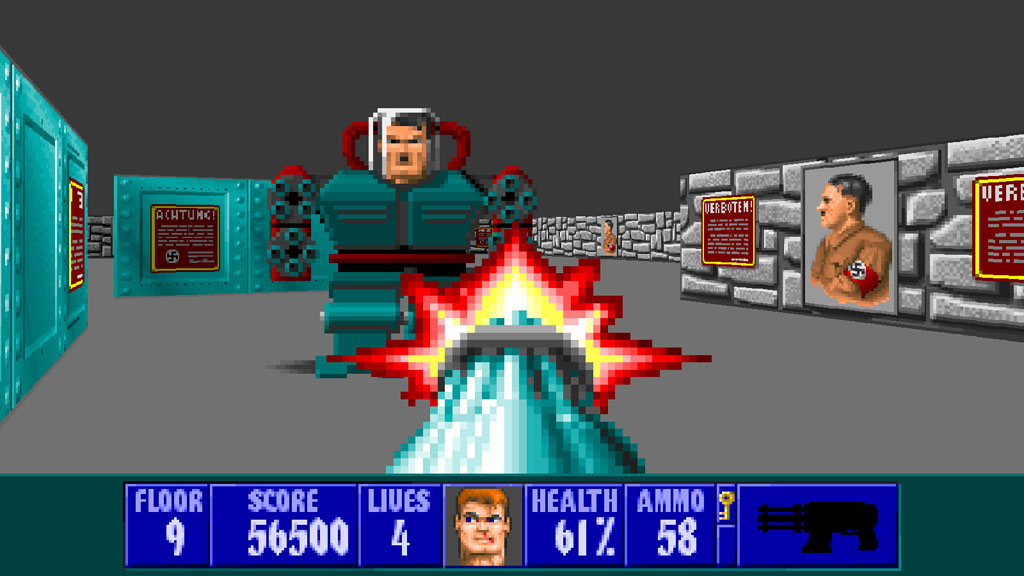
Wolfenstein

Culture, Media, War and Politics

wolf3db

“But Mom,” I said. “It’s killing Nazis!” Which didn’t win her over, exactly, but I did get to keep the game, and I managed to waste some moderate portion of my youth Playing Violent Video Games without ever killing anybody.

We live in society that will devote many fatuous hours discussing and deliberating the ill effects of video games and movies and rap songs and what have you. They are contributing to a “culture of violence” or some such. Meanwhile, the president actually has a kill list, and we accept the following as so banal that they escape the necessity of daily reporting:

111222013028-drone-victim-shakira-story-top AFG_drone_victim_in_hospital ali Drone attack victims Los-drones-o-el-ases-Pakistan-victim pic


You gonna blame Quentin Tarantino and Halo for that?