Wolfenstein

Culture, Media, War and Politics

wolf3db

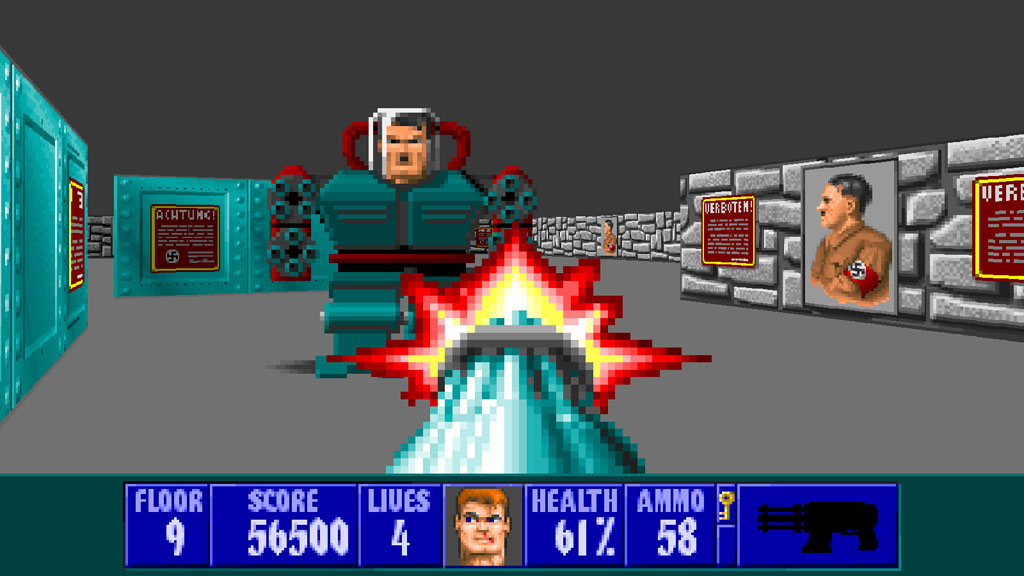
“But Mom,” I said. “It’s killing Nazis!” Which didn’t win her over, exactly, but I did get to keep the game, and I managed to waste some moderate portion of my youth Playing Violent Video Games without ever killing anybody.

We live in society that will devote many fatuous hours discussing and deliberating the ill effects of video games and movies and rap songs and what have you. They are contributing to a “culture of violence” or some such. Meanwhile, the president actually has a kill list, and we accept the following as so banal that they escape the necessity of daily reporting:

111222013028-drone-victim-shakira-story-top AFG_drone_victim_in_hospital ali Drone attack victims Los-drones-o-el-ases-Pakistan-victim pic


You gonna blame Quentin Tarantino and Halo for that?

Assholes Are Like Opinions, Everyone’s Got One, and Everyone’s Is Just His Opinion

Culture, War and Politics

Following a call by a French minister to censor certain so-called hateful speech, a Guardian writer wrote what I’d call a predictably contrarian piece praising limited forms of censorship, and Glenn Greenwald wrote a predictably outraged piece arguing that

 Nothing has been more destructive or dangerous throughout history – nothing – than the power of the state to suppress and criminalize opinions it dislikes.

Let’s say I’m not entirely convinced by this formulation, or by its corollary slippery slope: that the first infringement on free expression is the first step toward the camps. I mean, if we reject the notion that government-sanctioned gay marriage leads inexorably to interspecies romance or traditional Mormonism or whatever, then we’re also obliged to reject the notion that outlawing fag-baiting and Holocaust denial will march us straight into 1984.

Now I’m not in favor of government censorship, and The Higher Power According to Your Understanding of Him only knows that letting a bunch of self-satisfied énarques troll through hashtags, fishing for hatefulness and incivility and historical revisionism is a distressing—if also comic—proposition. But I do subscribe to this formulation:

First of all, I still lean to free speech absolutism. My position right now is to simply not give a shit about defending jerks.

That is to say, I think the left confuses the imperative to defend the least among us with the need to zealously defend the biggest fucking dickshits among us. The ACLU is great and all, but we completely over-valorize getting the Nazis a permit to march in Skokie. There’s a terrific irony underlying this notion that on the other side of prohibiting the swastika is inviting the yellow star. I do think the Nazis should be able to march past the synagogue and the Klan through downtown Birmingham, but we’ve too carefully cultivated the reflex to leap out of our seats when it seems that such ability might be curtailed.

Or, taking the French example, the conditions of extreme poverty and repression that obtain in the banlieues are much greater “threats”—are much more “destructive and dangerous”—than a bill to ban #SiMonFilsEtGay. That’s not to say that we need to fixate on one to the total exclusion of the other, but if we’re more concerned with assholes tweeting rank opinions (many of them not even the real, truly held opinions of their shock-seeking pseudonymous authors) than we are with the lack of a commuter line to Clichy-sous-Bois, then our allegiance is really to a hollow formalism rather than to the rights of human beings to live free, happy, comfortable, unmolested, and uncircumscribed lives.

In fairness, I believe that Glenn Greenwald would echo a lot of these sentiments, and it’s never fair to presume that a writer’s chosen emphasis implies the exclusion of other concerns. Still, there’s  tendency to swashbuckle into these absolutist arguments about free speech every time some C-list bureaucrat or columnist suggests cutting off this or that asshole’s microphone, which is rarely matched in intensity or duration when the police go storming in to nettoyer la cité au Kärcher. (Plenty of free-speech advocates are also prisoner’s rights advocates; are also drug law opponents; but as a matter of column inches, well . . .)

We saw a similar phenomenon when one of the Democratic Party hacks at the blog Lawyers, Guns, and Money made some shall-we-say intemperate comments about Wayne LaPierre in the moments immediately following the school shootings in Connecticut. Of course, a gang of right-wingers put on their shit-eatingest Schadenfreude grins and accused him of “eliminationist rhetoric”—a coinage popular on liberal blogs—for calling for Uncle Wayne’s “head on a spike.” Meanwhile, the blogger went on to call for the state to declare LaPierre a terrorist and toss his ass in jail. His university employer publicly regretted his comments, and a gang of luminous slightly-to-the-lefties circled the wagons and demanded that his freedom—his Academic Freedom, ye gods—be respected, with the implicit understanding that telling a guy to quit acting like a dick is the equivalent of Threatening His Job and Livelihood.

But people in much shittier and more precarious jobs all over America and all over the world actually get canned every day for mouthing off or using Facebook wrong or failing to ask the customer if they found everything they were looking for today, and that is the sort of injustice that demands our attention, not the plight of some entitled shitbag who felt that recent bloody events made for an opportune moment to advocate for criminalizing gun advocacy—that is to say, for supporting activities that, if lamentable, are legal in our society.

Insofar as there is a public debate about free speech, it’s largely confined to a neverending argument about the rights of privileged dickheads to be dickheads, and usually to each other. But most of humanity isn’t limited in the expressive sphere by censorship or hate speech laws or MPAA or whatever. It’s limited by poverty, imprisonment, the tyranny of intellectual property, the limitless powers of the boss, the cartel ownership of the means of communication. The terms of service are a bigger constraint on free expression than the Minister of Women’s Rights. The unequal distribution of wealth has more profound implications for speech than any statute.

The Franchise: The Title: The Subtitle: The Catchphrase: The Roman Numeral

Culture, Media, Movies

There’s a brief comic moment in the second Lord of the Rings film—I don’t think it occurs in the original book—where Gimli the dwarf tells the noble niece of the King of Rohan, a sort of half-Norse, half-Hunnish horse kingdom riding out of the North of Tolkein’s fictive world, that men mistakenly believe that there are no dwarf women, whereas in fact dwarf women simply look so much like dwarf men that outsiders can’t tell them apart. Then Viggo Mortenson, future King of Gondor, which is a sort of half-Roman, half-Most Serene Republic, half-Carolingian kingdom in the south, says to her, sotto voce: “It’s the beards.” It’s an odd, modern locution given Jackson’s general fidelity to LOTR’s ponderous inversions of contemporary English’s Subject-Verb-Object order: epic was the dialogue; but for comic relief ordinary English rarely spoke they. Anyway, this is the common complaint about Tolkein’s universe in general, isn’t it?–the women are just beards for a locker-room full of fellas who prefer the company of other fellas. Poor Cate Blanchett as the mighty elven woman Galadriel really sums it up back in the first installment. Offered the One Ring of Power, she transforms briefly into a weird obsidian-eyed vagina creature and intones ALL SHALL LOVE ME AND DESPAIR, enacting in summary the generally worry of the Tolkeinian universe.

The Hobbit dispenses with women altogether—or, the book does, but it seems less overtly . . . strange, if only because it’s really a boy’s own adventure tale. Cate makes an appearance in Jackson’s film, which, like a middle third trimester pregnancy is both immensely swollen and still unformed. I just reread The Hobbit, and it’s really a shame Jackson had to go and make it epic. It’s such a pleasant little adventure yarn, with a surprising surfeit of bitchy authorial asides. In fact, The Hobbit’s prose is remarkably un-ponderous. Stripped of Anglo-Saxonism, Tolkein can be bumptious and quite funny. The voice in the reader’s head is a slightly drunken English uncle amusing the children after dinner. It’s a shame Jackson stole the movie back from del Toro, who might’ve done the book more justice, having a better eye for both childhood and the grotesque, although for my money, the best choice would’ve been Terry Gilliam, whose Time Bandits (an outright homage to The Hobbit already) was far closer to the tone and tenor of Tolkein’s brisk little tale than this 3-hour prologue. The company of dwarves is permitted its slapstick, but when axe comes to neck, everyone transforms into a superhero, while Ian McKellan’s more mischievous Gandalf seems somewhat flummoxed as to how his later filmic self emerged from this character. The problem here is not so much that the movie is overlong, but that it’s overladen. I don’t mind a long movie where nothing much happens, but this ain’t Barry Lyndon. After a busy opening and then a long fallow section in Bilbo the Hobbit’s house, action arrives with predictable regularity—the problem isn’t the pacing, but the design, or the overdesign. The movie creaks under the burden of its overattention to detail. I did not watch the high frame rate version, but even in regular ol’ projection, it looked like a movie going into post-production rather than emerging from it. The lighting was often either too bright or too dim, and I kept waiting for a boom to drop into the frame or a dolly track appear in the leaves.

It would be unfair to single out Jackson for larding the movie with the many edifices of Tolkein’s, ahem, legendarium just to stretch it out and thus squeeze more fucking money out of it. After all, for every pretention otherwise, the very published existence of Tolkein’s tales and epics and lost tales and lost epics and lays and poems and songs and so on and so forth owes to his estate’s and his publisher’s desire to do precisely that: having exhausted his finished works, they ransacked his papers in order to make more money. Rather, the problem is that movies and heroes may no longer have a limited scope. The adventures of small people in a world that is obviously vast and mostly unknowable to them is actually quite interesting as a conceit, most especially when it’s basically a children’s story, but by constantly panning back and helicoptering skyward to reveal the size of the countryside and the goings-on the next country over, what’s meant to be wondrous become merely banal. In the book, all of this is hinted at just enough by the weird wizard’s occasional disappearance and reappearance, his errands simply implying that greater histories are being woven elsewhere; in the film, we have to follow him around. Far from making the world more wondrous, it makes it less so, over-explained and over-determined, not a story in its own right, but a mere prequel—worse, an origin story, the curse of modern fantasy and science fiction. What is Peter Jackson’s The Hobbit? It is the longest, most expensive DVD extra ever made.

Lightning Is Striking Again

Books and Literature, Conspiracy and the Occult, Things that Actually Happen

Point1948

So as some of you know and some of you don’t, I’ve written a book, about which I will engage in some shameless promotion later on. But in this book, there is a guy named Winston Pringle, who believes that the Point in Pittsburgh is a nexus of intense magical energy, an axis mundi, where the three phenomenal rivers and the fourth esoteric underground river join in mystical convergence. Anyway, my good friend John Allen and his friend Dave were in town, and in honor of the end of the Mayan long count calendar, we walked through a wild snow squall to the Point, whereupon we encountered that very–I thought, since I made him up–fictional conspiracy theorist. Actually, he claimed that he was Philip R. Ford, director of the semi-legendary Vegas in Space.

Well, he was just down there to soak up the energy and collect a little river water. We had a great talk. He also claimed to be the brother-in-law of Lou Christie, one of Pittsburgh’s great early pop stars, whom you probably know by his one big hit, “Lighting Strikes”, here performed by Klaus Nomi, because that’s what Phil would’ve wanted:

“I asked the park ranger back there if there were any events or celebrations planned today,” he said. He was resting on a park bench. He used a cane. He was wearing a sort of cowboy-cum-Homburg, a pin with the outline of a scorpion and a ring embossed with a black ankh. “But he said there was nothing.” We nodded. “Well,” he said, “I guess we’ve got the energy all to ourselves, just the four of us.” Then he told us the roasting pans in his grocery bag were for a Christmas goose.

“I know times are dark,” he said, “But I happen to think we’re coming into a better age. Our collective consciousness is making the change. It’s going to be a more matriarchal period. I’m pretty sure about that.”

You could barely see the stadium on the other side of the river because of the snow. A construction worker down by the fountain kept trying to light a cigarette in the wind.

The loveliest sentiments are what the rest of us call mad.

The Confluence of the Allegheny and Monongahela Rivers in December, 2012

Poetry

We thought the world would end, and so we made
a quiche, potato salad, lemonade,
and went down to the Point to watch the earth
open like a Titan giving birth
to a god, the rivers torn toward empty space
as if the edge of a medieval map, grace-
enshrouded, monster-guarded, void and deep
as an old mind entering death from sleep.
Well, shortly after noon it clouded up.
There was a little snow. A single boat
moved slowly toward the West End Bridge. I drank
some decent wine out of a plastic cup.
A distant siren sang a quavering note.
Someone tossed a stone, which skipped, then sank.

Burn After Spending

War and Politics

Christmas it seems to me is a necessary festival; we require a season when we can regret all the flaws in our human relationships: it is the feast of failure, sad but consoling.

-Our Man in Havana

Another reason I enjoy Graham Greene is that his bleak humor is so often prescient, proving the necessary point that comedy isn’t just the highest form of analysis, but the only form. He really could have written this story himself: two posh American dilettantes playing at playing at war, while the Generalissimo supposed to be in charge is bonking his amanuensis.

Actually, with all the awards dinners and jocular wine-soaked, clothed-and-skirted confabs, the thing smells just as much of Gilbert and Sullivan, but in Greeneland people actually die, and die horribly as a pesky side effect of human vanity and stupidity, and that’s the sad tale here. Two genuine American crackpots, experts on empires that have ceased to exist, got scam salaries from a non-profit DC racket and literally sent hundreds of Americans and god knows how many Afghans and Pakistanis to be killed, crippled, and maimed while the real officers were off porking a bunch of self-inflated, over-leveraged, Floridian yoga-and-pedicure arrivistes. At least Wormold did it for his daughter.

Perfectly, this article arrives simultaneously with its own publisher getting on the box to tell us that Chuck Hagel is insufficiently committed to setting giant piles of money on fire to serve as the Secretary of Defense. Really!

Mr. Hagel took a very different position when asked about Mr. Panetta’s comment during a September 2011 interview with the Financial Times. “The Defense Department, I think in many ways, has been bloated,” he responded. “So I think the Pentagon needs to be pared down.”

That’s being offered as a criticism. To even suggest such a thing is to be rendered unfit.

Well, the Washington Post is also a scam, the rump entertainment product of a test-prep rentier on the equally bloated American university industry, and there’s a great and ironic similarity between two scheming profs running a con dispensing advice to the generals and a scheming tabloid running a con by doing the same to the rest of the ruling class.

I suppose everyone will have to be shocked by this latest revelation about the petty venality of our modern-day Scipios, even though it’s the most unsurprising thing in the world. Talk about vanity. Our wars are nothing but, in both the modern and the ecclesiastical sense. The real long con here is on you, America. Your main man Obama is chucking your shitty retirement plan in the meat grinder while a couple of humanities Ph.D.s direct a quadrillion bones or clams of carnage halfway around the world. Your job sucks, you haven’t got any public transportation, your city is on the verge of bankruptcy, and your unpaid parking tickets have been reported to the credit ratings agency, making it impossible to refinance your crap mortgage. Don’t worry, though. Some dude who once expressed some mild skepticism about the non-personnel administrative expenses of the most lavishly, obscenely capitalized entity in the entire world may yet, despite the objections of The Potomac People’s Daily, get confirmed in some big-shot political job that you don’t really care about anyway.

The Holocene

Culture, Poetry

Don Quixote accidentally killed
the only extant wild giant left
in the world; we called the proximate cause of death
acute misapprehension, then we chilled
some DNA for future generations
who with gods-offending hubris will
regrow the race for gate receipts, though still
remain afraid of their immense creations.
But the clonal giants will not breed,
and will not eat, nor lift the sagging sky,
nor much at all but mope and slowly die,
allergic to the atmosphere, badly in need
of supplementary dietary myth
and oceans of fresh water to take it with.

The End of the Affair

Culture

The retreat from child rearing is, at some level, a symptom of late-modern exhaustion — a decadence that first arose in the West but now haunts rich societies around the globe.

As a reader, I’ve always enjoyed Catholic writers. Greene is my favorite modern novelist, and I’m the rare bird who finds the second half of Brideshead as enjoyable as the first. I like the fact that they seem to come to god so grudgingly; it lends credence to their conviction, as they, or their characters, are dragged kicking and screaming—or, well, mooning and whining—toward an inevitable appointment with the “appalling strangeness of the mercy of God.” So when I encounter an exuberant display of Catholicism, as I often do in the work of Ross Douthat, the springiest peacock in the Alcázarian gardens of the New York Times, I have my doubts as to whether what I’m reading is real or just a trick of light on the feathers.

“The retreat from child rearing is, at some level . . .” Rarely do you find a phrase working as mightily to support the rickety edifice balanced above it as that at some level. Rarely do you find a single gesture that stands out so glaringly from the movement all around it, a single bow going the wrong direction among the violins. If you’re going to accuse the West of exhaustion and decadence, you really need to drop the silk glove and draw the sword. It’s worth noting, at some level, that the company one keeps when one starts shot-putting decadence and exhaustion consists of Islamic fundamentalists, former Soviets, and mid-century fascists. Well, actually, those guys (they are all guys) have a point; the capitalistic West is decadent. Getting and spending, we lay waste our powers, and all that. But, while Bishop Douthat trims his tree with moral directives to the generations now living and those yet to come, the base is drinking from a shallow think tank full of MBA-styled phrases like “America’s demographic edge.”

So you see, the divine imperative to reproduce logarithmically is really about guarding a competitive advantage, and the commandment to go forth and multiply is to be read as a metaphor for GDP growth and a sustainable path for entitlement program funding. Each child is a unit of production; each retirement a cost; and Christ cries Why Has Thou Forsaken Me? from his perch where the  marginal cost and marginal benefit curves cross. If you want decadence, this is decadence, a society in which the act of sexual reproduction is as holy as the latest All Users email from HR.

Douthat isn’t alone in worrying about the slowing domestic production of Human Beings ®. Even The New Republic devoted a whole cover story to the Very Serious Problem of old ladies giving birth to retards. They go to lengths to phrase it very delicately in the language of pathology and neuroscience, but that is the fundamental concern. The freedom to delay childbirth may render our children eugenically unfit to rule the world that we have conquered for them. The partial liberation of women from their biological clocks may doom us to idiocracy. Or worse, a white minority, since only rich white ladies have the economic freedom and the health insurance to control their wombs.

All this makes for a pretty tawdry prelude to the vast outpouring of public grief over last week’s Connecticut rampage. Our most precious commodity struck down by our most fundamental constitutional right. I’m surprised the simultaneous occurrence of these two things didn’t tear a hole in the fabric of the universe itself.

What you will not hear in the crushingly predictable debate about guns, “freedom,” and security that we’re about to endure for the thousandth time is that our society is so terrifically violent because we don’t really value human life except as instrumental to other ends—economic production, the global war on terror, winning the future against China, whatever. Life has little value in and of itself; in the American worldview, we are all either future middle managers or future terrorists, depending mostly on the chance of the geography of our birth; the death of the former is to be lamented, the latter, if not cheered, ignored. But what makes them similar, those extinguished lives, is that for all our protestations to the contrary, we cannot value life as life; the very idea is antithetical to the manner in which our culture assigns value.

One of our more popular current entertainments features the specter of a desiccated future North America in which children are pitted against each other in gladiatorial combat; the rich are rewarded with exaltation, the poor with grief, but for everyone, the result is entertainment, diversion from their gray and daily lives. As the news continues and you find yourself diverted and horrified by the dreadful, inevitable drip-drip of grotesque forensic and psychological detail, well, are you not entertained?

Fixie

Culture

I’m an ancient thirty-one-year-old gay dude. Chocolate hurts my teeth and twinks make me want to hump razor wire and I maintain a curmudgeonly stance toward the trespassing universe as a general attitude, and yet I’m not able to muster a hatred for hipsters, that is, everyone younger than me. Where bores style themselves as thoroughly verklepmt at the ironic distance of our present era, I axe you, what is more affected, what is more pretentious, what is more self-conscious and artificial, a mustache and a vinyl collection, or the following sentence:

Born in 1977, at the tail end of Generation X, I came of age in the 1990s, a decade that, bracketed neatly by two architectural crumblings — of the Berlin Wall in 1989 and the Twin Towers in 2001 — now seems relatively irony-free.

The author goes on to identify grunge as an example of anti-ironism, which strongly suggests she never bothered decoding the lyrics to Nevermind. In fact, it suggests that the false nostalgia she hates in the hipsters is an altogether more subtle and accurate form of historical awareness than the acute nostalgia she feels for her own lost youth in a culture that hadn’t yet sold out.

The fall of the Berlin Wall was more world-historically meaningful than the destruction of the World Trade Centers, but in reality neither was all that significant in and of itself; both were superficial symptoms of larger histories, and the authorial decision to turn them into this sort of clever little trope, anchored to importance by what their destruction represents, is, actually, a form of irony, as is the fact that the same strophe is then transmogrified into a blunderbuss with which to take wild potshots at these kids today. Well, why not just throw in the Holocaust as well? Do you know that the hot hairstyle with cute boys these days is a direct throwback to late Weimar, cropped sides and long on top? I am sure it signifies an insufficient reverence for the greatest historical catastrophe ever to befall . . .

The idea that a tenured academic, a newspaper journalist, can instruct a lot of twenty-something party kids in how to recapture the childhood openness and emotional bigitude of a 4-year-old is pretty fucking ironic, too. It’s also pretty weird if you think about it for a minute. Collecting He-Man Action Figures and wearing handkerchiefs in your jean pockets is supposed to be a sign of arrested development, whereas pining for the preliterate mind of a child is a mark of the moral seriousness so sorely lacking in America. Who’s the fucking yolo here?

It is every person’s right and duty to hate fixed-gear bicycles, but to dress aesthetic prejudices in the drag of moral disapprobation is the act of a coward. The kids are having more fun that you, and they are less worried about getting fired from their job making smoothies at the co-op than you are at losing your TIAA-CREF accounts. No one likes getting older, but you can’t recapture your past by demanding that the present reenact that hazy image of it forever instagrammed in your spotty memory.